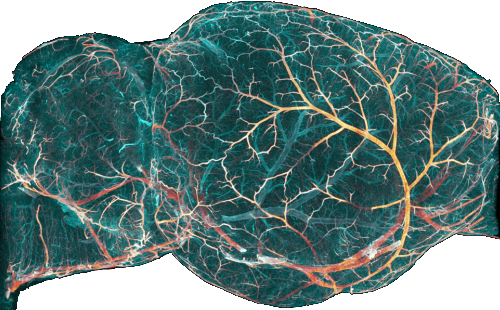
#!/usr/bin/env python2
# -*- coding: utf-8 -*-
"""
GraphVisualization
==================

Module providing tools to create meshes and visualize graphs.

"""
__author__ = 'Christoph Kirst <christoph.kirst.ck@gmail.com>'
__license__ = 'GPLv3 - GNU General Public License v3 (see LICENSE)'
__copyright__ = 'Copyright © 2020 by Christoph Kirst'
__webpage__ = 'https://idisco.info'
__download__ = 'https://www.github.com/ChristophKirst/ClearMap2'


import numpy as np

import functools as ft

import vispy.util.transforms as trf

import ClearMap.ParallelProcessing.SharedMemoryManager as smm
import ClearMap.ParallelProcessing.ParallelTraceback as ptb
import ClearMap.Analysis.Curves.Resampling as crs


###############################################################################
# ## Mesh generation
###############################################################################


[docs]
def mesh(graph=None, method='tubes', **kwargs):
    if method == 'tubes':
        return mesh_tube(graph, **kwargs)
    else:
        ValueError(f'Method n{method} not valid!')


###############################################################################
# ## Graph mesh using tubes
###############################################################################


[docs]
def mesh_tube(graph=None,
              coordinates=None, radii=None, indices=None,
              vertex_colors=None, edge_colors=None,
              n_tube_points=None, default_radius=1,
              color=None, default_color=(0.8, 0.1, 0.1, 1.0),
              processes=None, verbose=False):
    """Construct mesh from edge geometry of a graph."""
    if graph is not None:
        if graph.has_edge_geometry():  # FIXME: split into two functions
            if isinstance(coordinates, str):
                coordinates, indices = graph.edge_geometry(name=coordinates, return_indices=True, as_list=False)
            else:
                raise ValueError(f'Expected coordinates to by None or str, found {coordinates}!')

            try:
                name = radii if radii is not None else 'radii'
                radii = graph.edge_geometry(name=name, return_indices=False, as_list=False)
            except KeyError:
                print(f'No radii found in the graph, using uniform radii = {default_radius}!')
                radii = default_radius * np.ones(coordinates.shape[0])  # FIXME: dtype=float
        else:
            if isinstance(coordinates, str) and coordinates != 'coordinates':
                coordinates = graph.vertex_property(name=coordinates)
            else:
                coordinates = graph.vertex_coordinates()
            indices = graph.edge_connectivity().flatten()
            coordinates = np.vstack(coordinates[indices])
            try:
                radii = graph.vertex_radii()
                radii = radii[indices]
            except KeyError:
                print(f'No radii found in the graph, using uniform radii = {default_radius}!')
                radii = default_radius * np.ones(coordinates.shape[0])  # FIXME: dtype=float

            n_edges = graph.n_edges
            indices = np.array([2 * np.arange(0, n_edges), 2 * np.arange(1, n_edges+1)]).T

    if vertex_colors is not None:
        connectivity = graph.edge_connectivity()
        edge_colors = (vertex_colors[connectivity[:, 0]] + vertex_colors[connectivity[:, 1]]) / 2.0

    vertices, faces, colors = mesh_tube_from_coordinates_and_radii(coordinates, radii, indices,
                                                                   n_tube_points=n_tube_points,
                                                                   edge_colors=edge_colors,
                                                                   processes=None)

    return vertices, faces, colors


[docs]
def mesh_tube_from_coordinates_and_radii(coordinates, radii, indices, n_tube_points=8, edge_colors=None,
                                         processes=None, verbose=False):
    """Construct a mesh from the edge geometry of a graph."""
    coordinates_hdl = smm.insert(coordinates)
    radii_hdl = smm.insert(radii)
    indices_hdl = smm.insert(indices)

    func = ft.partial(_parallel_mesh, coordinates_hdl=coordinates_hdl, radii_hdl=radii_hdl, indices_hdl=indices_hdl, n_tube_points=n_tube_points, verbose=verbose)
    argdata = np.arange(len(indices))

    # process in parallel
    pool = smm.mp.Pool(processes=processes)
    results = pool.map(func, argdata)
    pool.close()
    pool.join()

    smm.free(coordinates_hdl)
    smm.free(radii_hdl)
    smm.free(indices_hdl)

    results = list(results)
    n_results = len(results)

    vertices = [np.reshape(r[0], (-1, 3)) for r in results]
    n_indices = [len(v) for v in vertices]
    n_indices = np.cumsum(n_indices)
    n_indices = np.hstack([[0], n_indices])

    if edge_colors is not None:
        # colors = [len(v) * [c] for v, c in zip(vertices, edge_colors)]
        edge_colors = np.array(edge_colors)
        if edge_colors.size in (3, 4):
            edge_colors = [edge_colors] * len(vertices)
        colors = [np.tile(c, [len(v), 1]) for v, c in zip(vertices, edge_colors)]  # TODO: check we always want this broadcasting
        colors = np.concatenate(colors)
    else:
        colors = None

    vertices = np.concatenate(vertices)
    faces = np.concatenate([results[i][1] + n_indices[i] for i in range(n_results)])

    return vertices, faces, colors


def _mesh(coordinates, radii, n_tube_points=15, dtype='uint32'):
    n_coordinates = len(coordinates)
    tangents, normals, binormals = _frenet_frames(coordinates)

    # circular tube
    v = np.arange(n_tube_points, dtype=float) / n_tube_points * 2 * np.pi
    c = np.cos(v)
    s = np.sin(v)

    r = radii[:, np.newaxis]
    n = normals * r
    b = binormals * r

    # grid shape (npoints, ntube, 3)
    grid = coordinates[:, np.newaxis, :] + c[np.newaxis, :, np.newaxis] * n[:, np.newaxis, :] + s[np.newaxis, :, np.newaxis] * b[:, np.newaxis, :]

    # construct the mesh
    n_segments = n_coordinates - 1
    jp = np.ones(n_segments*n_tube_points, dtype=int)
    jp[n_tube_points * np.arange(n_segments, dtype=int) - 1] -= n_tube_points

    i1 = np.arange(n_segments*n_tube_points, dtype=int)
    i2 = i1 + n_tube_points
    i3 = i2 + jp
    i4 = i1 + jp

    indices = np.array(np.vstack([np.array([i1, i2, i4]).T, np.array([i2, i3, i4]).T]), dtype=dtype)

    return grid, indices


def _frenet_frames(coordinates):
    """Calculates and returns the tangents, normals and binormals for a chain of coordinates."""
    n_points = len(coordinates)
    epsilon = 0.0001

    # compute tangent vectors for each segment
    tangents = np.roll(coordinates, -1, axis=0) - np.roll(coordinates, 1, axis=0)
    tangents[0] = coordinates[1] - coordinates[0]
    tangents[-1] = coordinates[-1] - coordinates[-2]
    tangents = (tangents.T / np.linalg.norm(tangents, axis=1)).T

    # get initial normal and binormal
    t = np.abs(tangents[0])
    smallest = np.argmin(t)
    normal = np.zeros(3, dtype=float)
    normal[smallest] = 1

    vec = np.cross(tangents[0], normal)

    normals = np.zeros((n_points, 3))
    normals[0] = np.cross(tangents[0], vec)

    # compute change along trajectory
    theta = np.arccos(np.clip(np.sum(tangents[:-1] * tangents[1:], axis=1), -1, 1))
    vec = np.cross(tangents[:-1], tangents[1:])
    nrm = np.linalg.norm(vec, axis=1)

    # compute normal and binormal vectors along the path
    for i in range(n_points-1):
        normals[i+1] = normals[i]

        if nrm[i] > epsilon:
            v = vec[i] / nrm[i]
            normals[i+1] = trf.rotate(-np.degrees(theta[i]), v)[:3, :3].dot(normals[i+1])

    binormals = np.cross(tangents, normals)

    return tangents, normals, binormals


@ptb.parallel_traceback
def _parallel_mesh(i, coordinates_hdl, radii_hdl, indices_hdl, n_tube_points=15, verbose=False):
    coordinates = smm.get(coordinates_hdl)
    radii = smm.get(radii_hdl)
    start, end = smm.get(indices_hdl)[i]

    coordinates = coordinates[start:end]
    radii = radii[start:end]

    if verbose:
        if i % 1000 == 0:
            print(f'Mesh calculation {i} / {len(smm.get(indices_hdl))}.')

    return _mesh(coordinates, radii, n_tube_points)


###############################################################################
# ## Render graph using intrepolation
###############################################################################


[docs]
def interpolate_edge_geometry(graph, smooth = 5, order = 2,
                              points_per_pixel = 0.5,
                              processes = None, verbose = False):
    """Smooth center lines and radii of the edge geometry."""
    if not graph.has_edge_geometry('coordinates'):
        raise ValueError('Graph has no edge geometry!')

    coordinates, indices = graph.edge_geometry('coordinates', return_indices=True, as_list=False)
    radii = graph.edge_geometry('radii', as_list=False)

    # prepare result arrays
    # indices_interp = np.array([_n_points_per_edge(i[1]-i[0], points_per_pixel=points_per_pixel) for i in indices]);
    # indices_interp = np.cumsum(indices_interp);
    # indices_interp = np.hstack([[0], indices_interp])
    # indices_interp = np.array([indices_interp[:-1], indices_interp[1:]]).T;

    # coordinates_interp = np.zeros((indices_interp[-1,1], coordinates.shape[1]), dtype=float);
    # radii_interp = np.zeros(indices_interp[-1,1], dtype=float);

    # process in parallel
    coordinates_hdl = smm.insert(coordinates)
    radii_hdl = smm.insert(radii)
    indices_hdl = smm.insert(indices)

    # coordinates_interp_hdl = smm.insert(coordinates_interp)
    # radii_interp_hdl       = smm.insert(radii_interp)
    # indices_interp_hdl     = smm.insert(indices_interp)

    func = ft.partial(_parallel_interpolate,
                      coordinates_hdl=coordinates_hdl, radii_hdl=radii_hdl, indices_hdl=indices_hdl,
                      # coordinates_interp_hdl=coordinates_interp_hdl, radii_interp_hdl=radii_interp_hdl, indices_interp_hdl=indices_interp_hdl,
                      smooth=smooth, order=order, points_per_pixel=points_per_pixel, verbose=verbose)
    argdata = np.arange(len(indices))

    pool = smm.mp.Pool(processes=processes)
    results = pool.map(func, argdata)
    pool.close()
    pool.join()

    smm.free(coordinates_hdl)
    smm.free(radii_hdl)
    smm.free(indices_hdl)

    results = list(results)

    # smm.free(coordinates_interp_hdl)
    # smm.free(radii_interp_hdl)
    # smm.free(indices_interp_hdl)

    indices_interp = np.array([len(r[1]) for r in results])
    indices_interp = np.cumsum(indices_interp)
    indices_interp = np.hstack([[0], indices_interp])
    indices_interp = np.array([indices_interp[:-1], indices_interp[1:]]).T

    coordinates_interp = np.vstack([r[0] for r in results])
    radii_interp = np.hstack([r[1] for r in results])

    return coordinates_interp, radii_interp, indices_interp


@ptb.parallel_traceback
def _parallel_interpolate(i, coordinates_hdl, radii_hdl, indices_hdl,
                          # coordinates_interp_hdl, radii_interp_hdl, indices_interp_hdl,
                          smooth=5, order=2, points_per_pixel=0.5, verbose=False):
    coordinates = smm.get(coordinates_hdl)
    radii = smm.get(radii_hdl)
    start, end = smm.get(indices_hdl)[i]

    # coordinates_interp = smm.get(coordinates_interp_hdl)
    # radii_interp = smm.get(radii_interp_hdl)
    # start_interp,end_interp = smm.get(indices_interp_hdl)[i]

    coordinates = coordinates[start:end]
    radii = radii[start:end]

    if verbose:
        if i % 1000 == 0:
            print(f'Mesh interpolation {i} / {len(smm.get(indices_hdl))}.')

    # coordinates_interp[start:end], radii_interp[start:end]=

    n_points = _n_points_per_edge(end-start, points_per_pixel=points_per_pixel)
    # n_points = end_interp - start_interp

    # coordinates_interp[start_interp:end_interp], radii_interp[start_interp:end_interp] =
    return _interpolate_edge(coordinates, radii, n_points=n_points,
                             smooth=smooth, order=order)


def _n_points_per_edge(n_pixel, points_per_pixel):
    n_points = int(np.ceil(n_pixel * points_per_pixel))
    n_points = max(2, n_points)
    return n_points


def _interpolate_edge(coordinates, radii, n_points, smooth=5, order=2):
    order = min(coordinates.shape[0]-1, order)
    coordinates_interp = crs.resample(coordinates, n_points=n_points, smooth=smooth, order=order)
    radii_interp = crs.resample(radii, n_points=n_points, smooth=smooth, order=order)
    return coordinates_interp, radii_interp


###############################################################################
# ## Tests
###############################################################################

def _test():
    import numpy as np
    import ClearMap.Tests.Files as tf
    import ClearMap.Analysis.graphs.graph_processing as gp
    # reload(gp)

    skeleton = tf.source('skeleton')

    # import ClearMap.Visualization.Plot3d as p3d
    # p3d.plot(skeleton)

    # reload(gp)
    g = gp.graph_from_skeleton(skeleton)

    g.has_edge_geometry()

    g.vertex_coordinates()

    s = g.skeleton()
    assert np.all(s == skeleton)

    gc = gp.clean_graph(g, verbose=True)

    gr = gp.reduce_graph(gc, verbose=True)

    coordinates, indices = gr.edge_geometry(return_indices=True, as_list=False)

    gr.set_edge_geometry(name='radii', values=np.ones(len(coordinates)))

    radii = gr.edge_geometry('radii', as_list=False)

    import ClearMap.Analysis.graphs.GraphVisualization as gv
    reload(gv)

    grid, grid_indices = gv.mesh_from_edge_geometry(coordinates=coordinates, radii=radii, indices=indices)

    import ClearMap.Visualization.GraphVisual as gvi

    gvi.plot_mesh(grid, grid_indices)