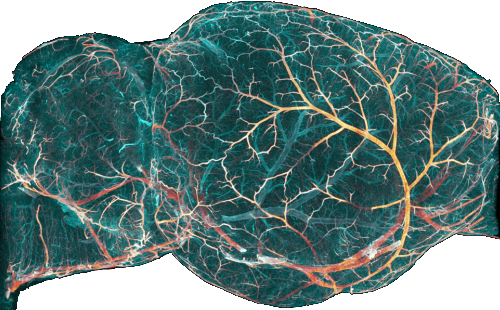
# -*- coding: utf-8 -*-
"""
Cells
=====

Expert cell image processing pipeline.

This module provides the basic routines for processing immediate early
gene data.

The routines are used in the :mod:`ClearMap.Scripts.CellMap` pipeline.
"""
__author__ = 'Christoph Kirst <christoph.kirst.ck@gmail.com>'
__license__ = 'GPLv3 - GNU General Public License v3 (see LICENSE.txt)'
__copyright__ = 'Copyright © 2020 by Christoph Kirst'
__webpage__ = 'https://idisco.info'
__download__ = 'https://github.com/ClearAnatomics/ClearMap'

import gc
import multiprocessing
import shutil
import tempfile
import warnings
from pathlib import Path

import numpy as np

import cv2
import pandas as pd
import scipy.ndimage.filters as ndf
import scipy.ndimage as ndi

import ClearMap.IO.IO as clearmap_io

import ClearMap.ParallelProcessing.BlockProcessing as bp
import ClearMap.ParallelProcessing.DataProcessing.ArrayProcessing as ap

import ClearMap.ImageProcessing.IlluminationCorrection as ic
import ClearMap.ImageProcessing.Filter.StructureElement as se
import ClearMap.ImageProcessing.Filter.FilterKernel as fk

import ClearMap.Analysis.Measurements.maxima_detection as md
import ClearMap.Analysis.Measurements.shape_detection as sd
import ClearMap.Analysis.Measurements.MeasureExpression as me

import ClearMap.Utils.Timer as tmr
from ClearMap.ImageProcessing.Experts.utils import initialize_sinks, run_step, print_params
from ClearMap.ImageProcessing.LocalStatistics import local_percentile

from ClearMap.Utils.exceptions import ClearMapValueError
from ClearMap.Utils.utilities import sanitize_n_processes

###############################################################################
# ## Default parameter
###############################################################################

default_cell_detection_parameter = dict(
    # flatfield
    illumination_correction=dict(flatfield=None,
                                 scaling='mean'),

    # background removal
    background_correction=dict(shape=(10, 10),
                               form='Disk',
                               save=False),

    # equalization
    equalization=None,

    # difference of gaussians filter
    dog_filter=dict(shape=None,
                    sigma=None,
                    sigma2=None),

    # extended maxima detection
    maxima_detection=dict(h_max=None,
                          shape=5,
                          threshold=0,
                          valid=True,
                          save=False),

    # cell shape detection
    shape_detection=dict(threshold=700,
                         save=False),

    # cell intensity detection
    intensity_detection=dict(method='max',
                             shape=3,
                             measure=['source', 'background_correction']),
)
"""Parameter for the cell detection pipeline.
See :func:`detect_cells` for details."""


default_cell_detection_processing_parameter = dict(
    size_max=100,
    size_min=50,
    overlap=32,
    axes=[2],
    optimization=True,
    optimization_fix='all',
    verbose=None,
    processes=None
)
"""Parallel processing parameter for the cell detection pipeline.
See :func:`ClearMap.ParallelProcessing.BlockProcessing.process` for details."""


###############################################################################
# ## Cell detection
###############################################################################


[docs]
def detect_cells(source, sink=None, cell_detection_parameter=default_cell_detection_parameter,
                 processing_parameter=default_cell_detection_processing_parameter, workspace=None):
    """Cell detection pipeline.

    Arguments
    ---------
    source : source specification
        The source of the stitched raw data.
    sink : sink specification or None
        The sink to write the result to. If None, an array is returned.
    cell_detection_parameter : dict
        Parameter for the binarization. See below for details.
    processing_parameter : dict
        Parameter for the parallel processing.
        See :func:`ClearMap.ParallelProcessing.BlockProcessing.process` for
        description of all the parameter.
    workspace: Workspace
        The optional workspace object to have a handle to cancel the multiprocess

    Returns
    -------
    sink : Source
        The result of the cell detection.

    Notes
    -----
    Effectively this function performs the following steps:
        * illumination correction via :func:`~ClearMap.ImageProcessing.IlluminationCorrection.correct_illumination`
        * background removal
        * difference of Gaussians (DoG) filter
        * maxima detection via :func:`~ClearMap.Analysis.Measurements.MaximaDetection.find_extended_maxima`
        * cell shape detection via :func:`~ClearMap.Analysis.Measurements.ShapeDetection.detect_shape`
        * cell intensity and size measurements via:
            :func:`~ClearMap.ImageProcessing.Measurements.ShapeDetection.find_intensity`,
            :func:`~ClearMap.ImageProcessing.Measurements.ShapeDetection.find_size`.


    The parameters for each step are passed as sub-dictionaries to the
    cell_detection_parameter dictionary.

    * If None is passed for one of the steps this step is skipped.
    * Each step also has an additional parameter 'save' that enables saving
        of the result of that step to a file to inspect the pipeline.


    Illumination correction
    -----------------------
    illumination_correction : dict or None
        Illumination correction step parameter.

        flatfield : array or str
            The flat field estimate for the image planes.

        background : array or None
            A background level to assume for the flatfield correction.

        scaling : float, 'max', 'mean' or None
            Optional scaling after the flat field correction.

        save : str or None
            Save the result of this step to the specified file if not None.

    See also :func:`ClearMap.ImageProcessing.IlluminationCorrection.correct_illumination`


    Background removal
    ------------------
    background_correction : dict or None
        Background removal step parameter.

        shape : tuple
            The shape of the structure element to estimate the background.
            This should be larger than the typical cell size.

        form : str
            The form of the structure element (e.g. 'Disk')

        save : str or None
            Save the result of this step to the specified file if not None.

    Equalization
    ------------
    equalization : dict or None
        Equalization step parameter.
        See also :func:`ClearMap.ImageProcessing.LocalStatistics.local_percentile`

        percentile : tuple
            The lower and upper percentiles used to estimate the equalization.
            The lower percentile is used for normalization, the upper to limit the
            maximal boost to a maximal intensity above this percentile.

        max_value : float
            The maximal intensity value in the equalized image.

        selem : tuple
            The structural element size to estimate the percentiles.
            Should be larger than the larger vessels.

        spacing : tuple
            The spacing used to move the structural elements.
            Larger spacings speed up processing but become locally less precise.

        interpolate : int
            The order of the interpolation used in constructing the full
            background estimate in case a non-trivial spacing is used.

        save : str or None
          Save the result of this step to the specified file if not None.


    DoG Filter
    ----------
    dog_filter : dict or None
        Difference of Gaussian filter step parameter.

        shape : tuple
            The shape of the filter.
            This should be near the typical cell size.

        sigma : tuple or None
             The std of the inner Gaussian.
             If None, determined automatically from shape.

        sigma2 : tuple or None
             The std of the outer Gaussian.
             If None, determined automatically from shape.

        save : str or None
            Save the result of this step to the specified file if not None.


    Maxima detection
    ----------------
    maxima_detection : dict or None
        Extended maxima detection step parameter.

        h_max : float or None
            The 'height' for the extended maxima.
            If None, simple local maxima detection is used.

        shape : tuple
            The shape of the structural element for extended maxima detection.
            This should be near the typical cell size.

        threshold : float or None
            Only maxima above this threshold are detected. If None, all maxima
            are detected.

        valid : bool
            If True, only detect cell centers in the valid range of the blocks with
            overlap.

        save : str or None
          Save the result of this step to the specified file if not None.


    Shape detection
    ---------------
    shape_detection : dict or None
        Shape detection step parameter.

        threshold : float
            Cell shape is expanded from maxima if pixels are above this threshold
            and not closer to another maxima.

        save : str or None
          Save the result of this step to the specified file if not None.


    Intensity detection
    -------------------
    intensity_detection : dict or None
        Intensity detection step parameter.

        method : {'max'|'min','mean'|'sum'}
            The method to use to measure the intensity of a cell.

        shape : tuple or None
            If no cell shapes are detected a disk of this shape is used to measure
            the cell intensity.

        save : str or None
            Save the result of this step to the specified file if not None.

    References
    ----------
    [1] Renier, Adams, Kirst, Wu et al., "Mapping of Brain Activity by Automated Volume Analysis of Immediate Early Genes.", Cell 165, 1789 (2016)
    [1] Kirst et al., "Mapping the Fine-Scale Organization and Plasticity of the Brain Vasculature", Cell 180, 780 (2020)
    """

    # initialize sink
    initialize_sinks(cell_detection_parameter, clearmap_io.shape(source), clearmap_io.order(source))

    cell_detection_parameter.update(verbose=processing_parameter.get('verbose', False))

    n_processes = sanitize_n_processes(processing_parameter.get('processes'))
    n_threads = max(1, int(multiprocessing.cpu_count() / n_processes))  # Number of threads so that * n_processes, fills CPUs

    sink_location = clearmap_io.location(sink) if sink is not None else None
    sink_path = Path(sink_location) if sink_location is not None else None
    result_directory = Path(tempfile.mkdtemp(prefix='cells_blocks_',
                                             dir=sink_path.parent if sink_path is not None else None))

    try:
        results = bp.process(detect_cells_block, source, sink=None, function_type='block', return_result=True,
                             return_blocks=False, parameter=cell_detection_parameter, workspace=workspace,
                             result_directory=result_directory, **{**processing_parameter, **{'n_threads': n_threads}})

        # merge results
        results = pd.concat((pd.read_feather(r) for r in results), ignore_index=True)

        # save results
        if sink is None:
            return results
        else:
            results.to_feather(sink)
            return sink

    finally:
        shutil.rmtree(result_directory, ignore_errors=True)


[docs]
def detect_cells_block(source, parameter=default_cell_detection_parameter,
                       n_threads=None, result_directory=None):
    """Detect cells in a Block.

    Returns
    -------
    pandas.DataFrame or str
        If ``result_directory`` is None, returns a DataFrame with explicit
        cell-property columns.

        If ``result_directory`` is provided, writes the block table to a
        per-block Feather file and returns the file path.
    """

    # initialize parameter and slicing
    if parameter.get('verbose'):
        prefix = 'Block %s: ' % (source.info(),)
        total_time = tmr.Timer(prefix)
    else:
        prefix = ''

    base_slicing = source.valid.base_slicing
    valid_slicing = source.valid.slicing
    valid_lower = source.valid.lower
    valid_upper = source.valid.upper
    lower = source.lower

    results = {}
    centers = None

    steps_to_measure = {}  # FIXME: rename
    parameter_intensity = parameter.get('intensity_detection')
    if parameter_intensity:
        parameter_intensity = parameter_intensity.copy()
        measure = parameter_intensity.pop('measure', [])
        measure = measure if measure else []
        valid_measurement_keys = list(default_cell_detection_parameter.keys()) + ['source']
        for m in measure:
            if m not in valid_measurement_keys:
                raise KeyError(f'Unknown measurement: {m}')
            steps_to_measure[m] = None
    else:
        measure = []

    if 'source' in steps_to_measure:
        steps_to_measure['source'] = source

    default_step_params = {'parameter': parameter, 'steps_to_measure': steps_to_measure, 'prefix': prefix,
                           'base_slicing': base_slicing, 'valid_slicing': valid_slicing}

    # WARNING: if param_illumination: previous_step = source, not np.array(source.array)
    corrected = run_step('illumination_correction', np.array(source.array),
                         ic.correct_illumination, **default_step_params)

    background = run_step('background_correction', corrected, remove_background,
                          remove_previous_result=True, **default_step_params)

    equalized = run_step('equalization', background, equalize, remove_previous_result=True,
                         extra_kwargs={'mask': None}, **default_step_params)

    dog = run_step('dog_filter', equalized, dog_filter,  # TODO: DoG filter != .title()
                   remove_previous_result=True, **default_step_params)

    # Maxima detection
    parameter_maxima = parameter.get('maxima_detection')
    parameter_shape = parameter.get('shape_detection')

    if parameter_shape or parameter_intensity:
        if not parameter_maxima:
            print(f'{prefix}Warning: maxima detection needed for shape and intensity detection!')
            parameter_maxima = {}

    if parameter_maxima:
        valid = parameter_maxima.pop('valid', None)
        maxima = run_step('maxima_detection', dog, md.find_maxima, extra_kwargs={'verbose': parameter.get('verbose')},
                          remove_previous_result=False, **default_step_params)
        # center of maxima
        if parameter_maxima['h_max']:  # FIXME: check if source or dog
            centers = md.find_center_of_maxima(source, maxima=maxima, verbose=parameter.get('verbose'))
        else:
            if parameter_shape:
                threshold = parameter_shape.get('threshold', 0)
                print(f'{prefix}masking maxima centers by (dog > {threshold}) for shape detection')
                mask = dog > threshold
                maxima = maxima * mask

            # We treat the eventuality of connected components of size>1 in the mask (maxima>0);
            # the choice of the structure matrix for connectivity could need discussion.
            # with no further adaptation the maxima_labeling consumes too much memory
            maxima_labels, _ = ndi.label(maxima, structure=np.ones((3,) * 3, dtype='bool'))
            centers = np.vstack(md.label_representatives(maxima_labels)).transpose()
            # we could come back to the ancient version
            # centers = ap.where(maxima, processes=n_threads).array
        del maxima

        # correct for valid region
        if valid:
            print('Filtering centers for correct block processing.')
            ids = np.ones(len(centers), dtype=bool)
            for c, l, u in zip(centers.T, valid_lower, valid_upper):
                ids = np.logical_and(ids, np.logical_and(l <= c, c < u))
            centers = centers[ids]
            del ids
    else:
        valid = None

    # cell shape detection  # FIXME: may use centers without assignment
    if parameter_shape:
        if parameter.get('verbose'):
            timer = tmr.Timer(prefix)
        try:
            parser = (lambda t: t[0])
            shape, sizes = run_step('shape_detection', dog, sd.detect_shape, remove_previous_result=True, **default_step_params,
            args = [centers], presave_parser=parser, extra_kwargs={'verbose': parameter.get('verbose'), 'processes': n_threads, 'return_sizes': True})
        except ClearMapValueError as err:
            if str(err) == 'An uint array with 0 values will lead to inconsistent results, consider a histogram transform or dtype conversion.':
                warnings.warn('This block is likely to contain corrupted data, an empty output will be provided for this block.')
                centers = centers[:0]
                sizes = np.array([], dtype=int)
                shape = None
            else:
                raise

        if parameter.get('verbose'):
            timer.print_elapsed_time('Shape detection')

        valid = sizes > 0
        results['size'] = sizes
    else:
        valid = None
        shape = None

    # cell intensity detection
    if parameter_intensity:
        parameter_intensity, timer = print_params(parameter_intensity, 'intensity_detection', prefix,
                                                  parameter.get('verbose'))

        if shape is not None:
            r = parameter_intensity.pop('shape', 3)
            if isinstance(r, tuple):
                r = r[0]

        for m in measure:
            if shape is not None:
                max_label = centers.shape[0]
                intensity = sd.find_intensity(steps_to_measure[m], label=shape,
                                              max_label=max_label, **parameter_intensity)
            else:  # WARNING: prange but me.measure_expression not parallel since processes=1
                # FIXME : How can r be defined in this branch ???
                intensity = me.measure_expression(steps_to_measure[m], centers, search_radius=r,
                                                  **parameter_intensity, n_processes=1, verbose=False)

            results[m] = intensity

        if parameter.get('verbose'):
            timer.print_elapsed_time('Intensity detection')

    # FIXME: extract DF creation
    if centers is None:
        centers = np.zeros((0, 3), dtype=int)

    if valid is not None:
        centers = centers[valid]
        results = {k: v[valid] for k, v in results.items()}
    # correct coordinate offsets of blocks
    centers = centers + lower

    # create named result table
    results = {'x': centers[:, 0], 'y': centers[:, 1], 'z': centers[:, 2], **results}

    if parameter_shape and 'size' not in results:  # TODO: check if required
        results['size'] = np.zeros(len(centers), dtype=int)

    for m in measure:
        if m not in results:
            results[m] = np.zeros(len(centers))

    results = pd.DataFrame(results)

    if result_directory is not None:
        result_directory.mkdir(exist_ok=True)

        block_id = source.iteration
        if block_id is None:
            block_id = 0

        result_path = result_directory / f'cells_block_{block_id:04d}.feather'
        results.to_feather(result_path)

        if parameter.get('verbose'):
            print(f'{prefix}Wrote block cell table: {result_path}, rows={len(results):d}, '
                  f'columns={list(results.columns)}', flush=True)

        results = result_path

    if parameter.get('verbose'):
        total_time.print_elapsed_time('Cell detection')

    gc.collect()

    return results


###############################################################################
# ## Cell detection processing steps
###############################################################################


[docs]
def remove_background(source, shape, form='Disk'):
    selem = se.structure_element(shape, form=form, ndim=2)  # FIXME: use skimage kernel
    selem = np.array(selem).astype('uint8')
    removed = np.empty(source.shape, dtype=source.dtype)
    for z in range(source.shape[2]):
        # img[:,:,z] = img[:,:,z] - grey_opening(img[:,:,z], structure=structureElement('Disk', (30,30)))
        # img[:,:,z] = img[:,:,z] - morph.grey_opening(img[:,:,z], structure=structureElement('Disk', (150,150)))
        removed[:, :, z] = source[:, :, z] - np.minimum(source[:, :, z],
                                                        cv2.morphologyEx(source[:, :, z], cv2.MORPH_OPEN, selem))
    return removed


[docs]
def dog_filter(source, shape, sigma=None, sigma2=None):
    if shape is not None:
        fdog = fk.filter_kernel(ftype='dog', shape=shape, sigma=sigma, sigma2=sigma2)
        fdog = fdog.astype('float32')
        filtered = ndf.correlate(source, fdog)
        filtered[filtered < 0] = 0
        return filtered
    else:
        return source


[docs]
def detect_maxima(source, h_max=None, shape=5, threshold=None, verbose=False):  # FIXME: use to refactor
    # extended maxima
    maxima = md.find_maxima(source, h_max=h_max, shape=shape, threshold=threshold, verbose=verbose)

    # center of maxima
    if h_max:
        centers = md.find_center_of_maxima(source, maxima=maxima, verbose=verbose)
    else:
        centers = ap.where(maxima).array  # FIXME: prange

    return centers


[docs]
def equalize(source, percentile=(0.5, 0.95), max_value=1.5, selem=(200, 200, 5), spacing=(50, 50, 5),
             interpolate=1, mask=None):
    equalized = local_percentile(source, percentile=percentile, mask=mask, dtype=float,
                                 selem=selem, spacing=spacing, interpolate=interpolate)
    normalize = 1/np.maximum(equalized[..., 0], 1)
    maxima = equalized[..., 1]
    ids = maxima * normalize > max_value
    normalize[ids] = max_value / maxima[ids]
    equalized = np.array(source, dtype=float) * normalize
    return equalized


###############################################################################
# ## Cell filtering
###############################################################################


[docs]
def filter_cells(source, sink, thresholds):
    """
    Filter an array of detected cells according to the thresholds.

    Arguments
    ---------
    source : str, array or Source
        The source for the cell data.
    sink : str, array or Source
        The sink for the results.
    thresholds : dict
        Dictionary of the form {name : threshold} where name refers to the
        column in the cell data and threshold can be None, a float
        indicating a minimal threshold or a tuple (min, max) where min, max can be
        None or a minimal and maximal threshold value.

    Returns
    -------
    sink : str, array or Source
        The thresholded cell data.
    """
    source = clearmap_io.open_ro(source)

    cells_mask = np.ones(source.shape[0], dtype=bool)
    for filter_name, thrsh in thresholds.items():
        if thrsh is not None:
            if not isinstance(thrsh, (tuple, list)) and isinstance(thrsh, (int, float)):
                thrsh = (thrsh, None)
            if thrsh[0] is not None:  # high pass
                cells_mask = np.logical_and(cells_mask, thrsh[0] <= source[filter_name])
            if thrsh[1] is not None:  # low pass
                cells_mask = np.logical_and(cells_mask, thrsh[1] > source[filter_name])
    cells_filtered = source[cells_mask]

    return clearmap_io.write(sink, cells_filtered)


###############################################################################
# ## Tests
###############################################################################

def _test():
    """Tests."""