#!/usr/bin/env python2
# -*- coding: utf-8 -*-
"""
tube_map
========
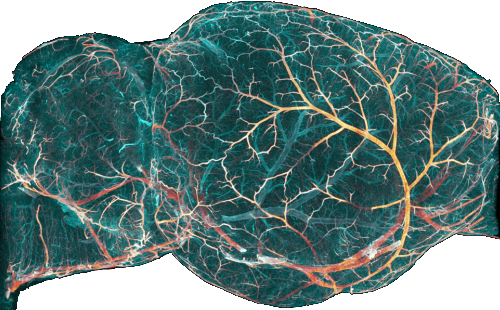
Vasculature binarization, graph construction, and vessel-type annotation.
Two pipeline workers are defined here:
:class:`BinaryVesselProcessor`
Converts raw fluorescence volumes into a binary vascular mask.
Steps (configurable order via the GUI pipeline widget):
1. **Binarize** — multi-path thresholding
(:mod:`~ClearMap.ImageProcessing.Experts.Vasculature`).
2. **Smooth** — topology-preserving binary smoothing.
3. **Fill** — parallel 3-D binary hole filling.
4. **Deep fill** — CNN-based hollow-tube filling
(:mod:`~ClearMap.ImageProcessing.machine_learning.vessel_filling`).
Multiple channels (e.g. all-vessels + arteries) are merged by
:meth:`~BinaryVesselProcessor.combine_binary`.
Step state is tracked by :class:`BinaryVesselProcessorSteps`.
:class:`VesselGraphProcessor`
Converts the combined binary mask into an annotated vascular graph:
1. **Skeletonize** — topology-preserving 3-D thinning.
2. **Build** — raw graph from skeleton, radius measurement, artery/vein
expression sampling.
3. **Clean** — clique removal.
4. **Reduce** — degree-2 vertex contraction; edge geometry stored.
5. **Register** — atlas-space transform, radius scaling, annotation,
distance-to-surface labelling.
6. **Post-process** — iterative artery/vein hysteresis tracing.
Step state is tracked by :class:`VesselGraphProcessorSteps`.
Radius units
------------
The graph processor handles three legacy precision levels
(:class:`VesselGraphProcessor.RadiusLevel`):
* **FULL** — spacing + per-axis µm radii (current).
* **SCALAR_UM** — spacing + scalar µm radii (intermediate legacy).
* **VOXELS** — voxel-space radii only (old graphs, :class:`DeprecationWarning` emitted).
Typical usage
-------------
Both workers are accessed via
:class:`~ClearMap.pipeline_orchestrators.experiment_controller.ExperimentController`::
binary = exp_ctrl.get_worker('vasculature', substep='binary')
graph = exp_ctrl.get_worker('vasculature', substep='graph')
binary.binarize()
binary.postprocess('vessels')
binary.combine_binary()
graph.skeletonize_and_build_graph(binary_processor=binary)
graph.clean_graph()
graph.reduce_graph()
graph.register()
graph.post_process()
See also
--------
:mod:`ClearMap.ImageProcessing.Experts.Vasculature` : Binarization algorithms.
:mod:`ClearMap.ImageProcessing.machine_learning.vessel_filling` : CNN vessel filling.
:mod:`ClearMap.Analysis.graphs.graph_processing` : Graph construction and reduction.
:class:`~ClearMap.Analysis.graphs.graph_gt.Graph` : Graph data structure.
[Kirst2020]_.
"""
from __future__ import annotations
import os
import copy
import re
import functools
import platform
import warnings
import gc
from concurrent.futures import ProcessPoolExecutor
from enum import Enum
from pathlib import Path
from typing import Optional, Dict, Any, Union, Callable
import numpy as np
import pandas as pd
from PyQt5.QtWidgets import QDialogButtonBox
import ClearMap.IO.IO as clearmap_io
from ClearMap.IO.Source import Source
from ClearMap.IO.workspace2 import Workspace2
from ClearMap.IO.workspace_asset import Asset
from ClearMap.config.config_coordinator import ConfigCoordinator
from ClearMap.pipeline_orchestrators.generic_orchestrators import PipelineOrchestrator, ProcessorSteps
import ClearMap.Alignment.Resampling as resampling_module
import ClearMap.Alignment.Elastix as elastix
from ClearMap.ParallelProcessing.DataProcessing.ArrayProcessing import initialize_sink
import ClearMap.ParallelProcessing.BlockProcessing as block_processing
import ClearMap.ImageProcessing.Experts.Vasculature as vasculature
import ClearMap.ImageProcessing.machine_learning.vessel_filling.vessel_filling as vessel_filling
import ClearMap.ImageProcessing.Skeletonization.Skeletonization as skeletonization
import ClearMap.ImageProcessing.Binary.Filling as binary_filling
import ClearMap.Analysis.Measurements.MeasureExpression as measure_expression
import ClearMap.Analysis.Measurements.radius_measurements as measure_radius
import ClearMap.Analysis.Measurements.Voxelization as voxelization
from ClearMap.Analysis.graphs import graph_processing
from ClearMap.Analysis.graphs.graph_filters import GraphFilter
from ClearMap.gui.dialog_helpers import warning_popup
from ClearMap.Utils.utilities import is_in_range, get_free_v_ram, clear_cuda_cache, sanitize_n_processes
from ClearMap.Utils.exceptions import (PlotGraphError, ClearMapVRamException,
MissingRequirementException, MissingAssetError, AssetNotFoundError,
ClearMapAssetError, ClearMapValueError)
from .sample_info_management import SampleManager
from .registration_orchestrator import RegistrationProcessor
from ..Analysis.graphs.graph_processing import Percentile
from ..Analysis.graphs.vessel_classifier import ClassificationConfig, VesselClassifier
__author__ = ('Christoph Kirst <christoph.kirst.ck@gmail.com>,'
' Sophie Skriabine <sophie.skriabine@icm-institute.org>,'
' Charly Rousseau <charly.rousseau@icm-institute.org>')
__license__ = 'GPLv3 - GNU General Public License v3 (see LICENSE)'
__copyright__ = 'Copyright © 2020 by Christoph Kirst'
__webpage__ = 'https://idisco.info'
__download__ = 'https://github.com/ClearAnatomics/ClearMap'
MAX_PLOT_VERTICES = 300_000 # Empirical max number of vertices that can safely be plotted
USE_BINARY_POINTS_FILE = not platform.system().lower().startswith('darwin')
_SourcePath = Union[Path, str]
[docs]
class VesselGraphProcessorSteps(ProcessorSteps):
graph_raw = 'raw'
graph_cleaned = 'cleaned'
graph_reduced = 'reduced'
graph_annotated = 'annotated'
_default_steps = (graph_raw, graph_cleaned, graph_reduced, graph_annotated) # TODO: add traced
[docs]
def asset_from_step_name(self, step):
return self.workspace.get('graph', channel=self.channel, asset_sub_type=step)
[docs]
class BinaryVesselProcessorSteps(ProcessorSteps):
stitched = 'stitched'
binary = 'binary'
smoothed = 'smoothed'
deep_filled = 'deep_filled'
filled = 'filled'
combined = 'combined'
final = 'final'
_default_steps = (stitched, binary, smoothed, deep_filled, filled, combined, final)
# Fixed anchors that cannot be reordered
_prefix_steps = (stitched, binary)
_suffix_steps = (combined, final)
_GUI_STEP_TO_ASSET: dict[str, str] = {
'binarize': 'binary',
'smooth': 'smoothed',
'binary_fill': 'filled',
'deep_fill': 'deep_filled',
}
_BINARIZE_STEP_MAP: dict[str, tuple[str, bool]] = {
'binarize': ('binarize_channel', False),
'smooth': ('smooth_channel', False),
'binary_fill': ('fill_channel', True), # prange — must be main thread
'deep_fill': ('deep_fill_channel', False),
}
_lifecycle_steps: frozenset[str] = frozenset({stitched, combined, final})
def __init__(self, workspace, channel, config_provider: Callable[[], dict] | None = None):
self._config_provider = config_provider or (lambda: {})
super().__init__(workspace, channel)
self._outputs: Dict[str, _SourcePath] = {}
self._pending_cleanup: list[str] = [] # canonical paths to delete
@classmethod
def _default_middle_steps(cls) -> tuple[str, ...]:
"""Steps between prefix and suffix, derived from _default_steps."""
anchors = set(cls._prefix_steps) | set(cls._suffix_steps)
return tuple(s for s in cls._default_steps if s not in anchors)
[docs]
def asset_from_step_name(self, step): # FIXME: split step and substep
if step in (self.stitched, self.binary):
asset = self.workspace.get(step, channel=self.channel)
else:
asset = self.workspace.get('binary', channel=self.channel, asset_sub_type=step)
return asset
@property
def steps(self) -> tuple[str, ...]:
"""
Compute step order fresh on each access — reflects any GUI
reordering committed to config since construction.
"""
cfg_order = self._config_provider().get('step_order')
prefix = list(self._prefix_steps)
suffix = list(self._suffix_steps)
anchor_assets = set(self._prefix_steps) | set(self._suffix_steps)
if cfg_order:
middle = [self._GUI_STEP_TO_ASSET[name]
for name in cfg_order
if name in self._GUI_STEP_TO_ASSET
and self._GUI_STEP_TO_ASSET[name] not in anchor_assets]
else:
middle = list(self._default_middle_steps())
return tuple(prefix + middle + suffix)
# ################################# output tracking ####################################
@staticmethod
def _extract_backing_path(output: Any) -> _SourcePath:
"""
Extract a plain path from whatever a step produces.
Asset → .path, Source → .location, Path/str → as-is.
Never stores a live Source or array — clearmap_io
reconstructs on demand.
"""
if isinstance(output, Asset):
return output.path
elif isinstance(output, Source): # covers MMP.Source, npy.Source …
return output.location
elif isinstance(output, (Path, str)):
return output
else:
raise ClearMapValueError(f'Output can only be a path/str, Asset or Source. Got {type(output)}')
# return output # unexpected — caller will fail loudly
[docs]
def record_output(self, asset: str, output: Any,
temp_path: str = '', keep: bool = False) -> None:
"""
Store the backing path of a completed step.
Source objects are serialisable path handles — we extract .path so
_outputs holds only plain Paths, never live Source instances.
clearmap_io reconstructs on demand.
"""
output_path = self._extract_backing_path(output)
self._outputs[asset] = output_path
if output_path and not keep:
self._pending_cleanup.append(str(output_path))
[docs]
def consume_and_cleanup(self) -> None:
"""Delete the pending temp file once the next step has consumed its input."""
for to_clean in self._pending_cleanup:
try:
clearmap_io.delete_file(to_clean)
except Exception:
pass
self._pending_cleanup = []
[docs]
def get_source(self, current_asset: str) -> _SourcePath:
"""
Walk backward from current_asset through the configured (non-lifecycle)
step order and return the first available backing path.
Precedence per previous step:
1. In-memory result stored by record_output (is-not-None guard)
2. On-disk asset
3. Raw binary (fallback)
Callers reconstruct the Source with clearmap_io.
"""
order = [s for s in self.steps if s not in self._lifecycle_steps]
try:
current_idx = order.index(current_asset)
except ValueError:
return self.asset_from_step_name(self.binary).path
for prev_asset in reversed(order[:current_idx]):
stored = self._outputs.get(prev_asset)
if stored is not None:
return stored
try:
asset = self.get_asset(prev_asset)
if asset.exists:
return asset.path
except (KeyError, AttributeError, FileNotFoundError,
AssetNotFoundError, ClearMapAssetError): # For skipped steps
continue
return self.asset_from_step_name(self.binary).path
[docs]
def get_last_output(self) -> _SourcePath:
"""
Return the last available output path, used by combine_binary.
"""
order = [s for s in self.steps if s not in self._lifecycle_steps]
for step in reversed(order):
stored = self._outputs.get(step)
if stored is not None:
return stored
try:
asset = self.get_asset(step)
if asset.exists:
return asset.path
except (IndexError, KeyError, AttributeError, FileNotFoundError):
continue
raise FileNotFoundError(f'No binary output found for channel "{self.channel}"')
[docs]
class BinaryVesselProcessor(PipelineOrchestrator):
config_name = 'vasculature'
def __init__(self, sample_manager: Optional[SampleManager] = None,
config_coordinator: Optional[ConfigCoordinator] = None):
super().__init__(config_coordinator)
self.sample_manager: Optional[SampleManager] = None
self.workspace: Optional[Workspace2] = None
self.inputs_match = False
self.inputs_shapes: tuple = (None, None)
self.all_vessels_channel: str = ''
self.arteries_channel: str = ''
# TODO: add veins too
self.steps: Dict[str, BinaryVesselProcessorSteps] = {}
self.block_re = ('Processing block',
re.compile(r'.*?Processing block \d+/\d+.*?\selapsed time:\s\d+:\d+:\d+\.\d+'))
self.vessel_filling_re = ('Vessel filling',
re.compile(r'.*?Vessel filling: processing block \d+/\d+.*?\selapsed time:\s\d+:\d+:\d+\.\d+'))
self.setup(sample_manager)
[docs]
def setup(self, sample_manager=None):
self.sample_manager = sample_manager if sample_manager is not None else self.sample_manager
if self.sample_manager is not None and self.sample_manager.setup_complete:
self.workspace = self.sample_manager.workspace
self.all_vessels_channel = self.sample_manager.get_channels_by_type(channel_type='vessels')
if not self.all_vessels_channel:
warnings.warn('Vessels channel not set')
return
# noinspection PyTypeChecker
self.arteries_channel = self.sample_manager.get_channels_by_type(channel_type='arteries',
multiple_found_action='warn')
self.assert_input_shapes_match()
all_channels = self.sample_manager.channels
obsolete_channels = [k for k in self.steps if k not in all_channels]
for k in obsolete_channels:
del self.steps[k]
for channel_name in self.channels_to_binarize():
if channel_name:
self.steps[channel_name] = BinaryVesselProcessorSteps(
self.workspace, channel=channel_name,
config_provider=lambda ch=channel_name: (
self.config.get('binarization', {}).get('single_channels', {}).get(ch, {})))
compound_channel = tuple(self.channels_to_binarize()) # FIXME: old keys not cleared
sample_id = self.sample_manager.prefix
self.workspace.ensure_pipeline('TubeMap', compound_channel, sample_id=sample_id,
channel_content_type='compound', create_channel=True)
# ############################### INPUTS ###############################
[docs]
def channels_to_binarize(self):
return self.sample_manager.get_channels_by_pipeline('TubeMap', as_list=True)
[docs]
def assets_to_binarize(self) -> list[Any]:
channels_to_binarize = self.channels_to_binarize()
assets_to_binarize = [self.workspace.get('stitched', channel=c) for c in channels_to_binarize]
return assets_to_binarize
# ############################# PUBLIC API ######################################
[docs]
def run(self):
self.binarize()
for channel in self.channels_to_binarize():
self.postprocess(channel)
self.combine_binary()
[docs]
def binarize(self):
if not self.inputs_match:
self.assert_input_shapes_match()
if self.inputs_match:
for channel in self.channels_to_binarize():
self.binarize_channel(channel)
else:
raise ValueError('Channels to binarize have different shapes. This is not supported yet.')
[docs]
def postprocess(self, channel: str) -> None:
"""
Run post-processing steps (smooth, fill, deep_fill) for *channel* in
the order declared by step_order in the config.
Binarize is always the first step and is excluded here — it runs via
binarize() / binarize_channel() before postprocess is called.
"""
dispatch: Dict[str, Callable] = {
BinaryVesselProcessorSteps.smoothed: self.smooth_channel,
BinaryVesselProcessorSteps.filled: self.fill_channel,
BinaryVesselProcessorSteps.deep_filled: self.deep_fill_channel,
}
for step in self.steps[channel].steps:
if step in BinaryVesselProcessorSteps._lifecycle_steps or step == BinaryVesselProcessorSteps.binary:
continue
fn = dispatch.get(step)
if fn is not None:
fn(channel)
def __get_n_blocks(self, channel):
# TODO: use actual processing params to get real n blocks
dim_size = self.get('stitched', channel=channel).shape()[2]
blk_size = vasculature.default_binarization_processing_parameter['size_max']
overlap = vasculature.default_binarization_processing_parameter['overlap']
n_blocks = int(np.ceil((dim_size - blk_size) / (blk_size - overlap) + 1))
return n_blocks
[docs]
@staticmethod
def setup_channel_operation(operation):
@functools.wraps(operation)
def wrapper(self, channel, *args, **kwargs):
operation_type = operation.__name__.replace('_channel', '')
if operation_type == 'deep_fill':
n_blocks = 1200
else:
n_blocks = self.__get_n_blocks(channel)
asset_to_gui = {v: k for k, v in BinaryVesselProcessorSteps._GUI_STEP_TO_ASSET.items()}
gui_order = [asset_to_gui[stp] for stp in self.steps[channel].steps
if stp not in BinaryVesselProcessorSteps._lifecycle_steps]
# and stp in asset_to_gui] # TODO: check guard against unknown steps
first_op = gui_order[0] if gui_order else operation_type
first_step = channel == self.channels_to_binarize()[0] and operation_type == first_op
increment_main = not first_step
self.prepare_watcher_for_substep(n_blocks, self.block_re,
f'{operation_type} {channel.title()}', increment_main)
return operation(self, channel, *args, **kwargs)
return wrapper
[docs]
@setup_channel_operation
def binarize_channel(self, channel):
self._binarize(channel) # TODO: update watcher
[docs]
@setup_channel_operation
def smooth_channel(self, channel):
self._smooth(channel) # TODO: update watcher
[docs]
@setup_channel_operation
def fill_channel(self, channel): # WARNING: should run from main thread
self._fill(channel) # TODO: update watcher
[docs]
@setup_channel_operation
def deep_fill_channel(self, channel): # n_blocks because of decorator
self._deep_fill_channel(channel) # TODO: update watcher
def _binarize(self, channel):
"""
postfix str
empty for raw
"""
binarization_cfg = self.config['binarization']['single_channels'][channel]
if not binarization_cfg['binarize']['run']:
return
self.steps[channel].remove_next_steps_files(self.steps[channel].binary)
source = self.workspace.source('stitched', channel=channel)
sink = self.get_path('binary', channel=channel)
binarization_parameter = copy.deepcopy(vasculature.default_binarization_parameter)
binarization_parameter['clip']['clip_range'] = binarization_cfg['binarize']['clip_range']
deconvolve_threshold = binarization_cfg['binarize']['threshold']
if deconvolve_threshold is not None:
binarization_parameter['deconvolve']['threshold'] = deconvolve_threshold
if channel != self.all_vessels_channel: # For arteries or veins
binarization_parameter.update(equalize=None, vesselize=None)
processing_parameter = copy.deepcopy(vasculature.default_binarization_processing_parameter)
channel_perf = self.config['performance']['binarization']['single_channels'][channel]
block_params = channel_perf['binarize']['block_processing']
processing_parameter.update(
processes=sanitize_n_processes(block_params['n_processes']),
size_min=block_params['size_min'], size_max=block_params['size_max'],
overlap=block_params['overlap'], as_memory=True, verbose=True)
vasculature.binarize(source, sink,
binarization_parameter=binarization_parameter,
processing_parameter=processing_parameter)
keep = binarization_cfg['binarize'].get('save', True)
self.steps[channel].record_output(BinaryVesselProcessorSteps.binary, sink, keep=keep)
[docs]
def plot_binarization_result(self, parent=None, channel='', arrange=False):
"""
channel str:
The channel to plot
"""
from ClearMap.Visualization.Qt import Plot3d as q_p3d
images = [(self.get_path('stitched', asset_sub_type=channel)),
(self.get_path('binary', asset_sub_type=channel))]
dvs = q_p3d.plot(images, title=[img.name for img in images],
arrange=arrange, lut=self.machine_config['default_lut'], parent=parent)
return dvs
def _smooth(self, channel):
binarization_cfg = self.config['binarization']['single_channels'][channel]
if not binarization_cfg['smooth']['run']:
return
self.steps[channel].remove_next_steps_files(self.steps[channel].smoothed)
source = self.steps[channel].get_source(BinaryVesselProcessorSteps.smoothed)
source = clearmap_io.open_ro(source)
sink_path = self.get_path('binary', channel=channel, asset_sub_type='smoothed')
smoothing_parameters = copy.deepcopy(vasculature.default_postprocessing_parameter['smooth'])
channel_perf = self.config['performance']['binarization']['single_channels'][channel]
perf_cfg = channel_perf['smooth']['block_processing']
perf_params = copy.deepcopy(vasculature.default_postprocessing_processing_parameter)
perf_params.update(size_max=perf_cfg['size_max'])
result = vasculature.apply_smoothing(source, sink_path, smoothing_parameters, perf_params,
processes=sanitize_n_processes(perf_cfg['n_processes']),
verbose=True)
self.steps[channel].consume_and_cleanup()
keep = binarization_cfg['smooth'].get('save', True)
self.steps[channel].record_output(BinaryVesselProcessorSteps.smoothed, result[1], keep=keep)
def _fill(self, channel):
if not self.config['binarization']['single_channels'][channel]['binary_fill']['run']:
return
self.steps[channel].remove_next_steps_files(self.steps[channel].filled)
source = self.steps[channel].get_source(BinaryVesselProcessorSteps.filled)
source = clearmap_io.open_ro(source)
sink = self.get_path('binary', channel=channel, asset_sub_type='filled')
sink = initialize_sink(sink, shape=source.shape, dtype=source.dtype, order=source.order, return_buffer=False)
perf_cfg = self.config['performance']['binarization']['single_channels'][channel]['binary_fill']
binary_filling.fill(source, sink=sink, processes=sanitize_n_processes(perf_cfg['n_processes']),
verbose=True)
self.steps[channel].consume_and_cleanup()
keep = self.config['binarization']['single_channels'][channel]['binary_fill'].get('save', True)
self.steps[channel].record_output(BinaryVesselProcessorSteps.filled, sink, keep=keep)
def _deep_fill_channel(self, channel, size_max=None, overlap=None, resample_factor=None):
binary_cfg = self.config['binarization']['single_channels'][channel]
if not binary_cfg['deep_fill']['run']:
return
perf_params = self.config['performance']['binarization']['single_channels'][channel]['deep_fill']['block_processing']
REQUIRED_V_RAM = 22000 # REFACTOR: put in config or at top of module
if size_max is None:
size_max = perf_params['size_max']
if overlap is None:
overlap = perf_params['overlap']
if resample_factor is None:
resample_factor = binary_cfg['deep_fill']['resample_factor']
if not get_free_v_ram() > REQUIRED_V_RAM:
btn = warning_popup(f'Insufficient VRAM',
f'You do not have enough free memory on your graphics card to '
f'run this operation. This step needs 22GB VRAM, {get_free_v_ram() / 1000} were found. '
f'Please free some or upgrade your hardware.')
if btn == QDialogButtonBox.Abort:
raise ClearMapVRamException(f'Insufficient VRAM, found only {get_free_v_ram()} < {REQUIRED_V_RAM}')
elif btn == QDialogButtonBox.Retry:
self._deep_fill_channel(channel, size_max, overlap, resample_factor)
self.steps[channel].remove_next_steps_files(self.steps[channel].deep_filled)
# TODO: check how source casts to bool
source = self.steps[channel].get_source(BinaryVesselProcessorSteps.deep_filled)
sink = self.get_path('binary', channel=channel, asset_sub_type='deep_filled')
processing_parameter = copy.deepcopy(vessel_filling.default_fill_vessels_processing_parameter)
processing_parameter.update(size_max=size_max, size_min='fixed', axes='all', overlap=overlap)
vessel_filling.fill_vessels(source, sink, resample=resample_factor, threshold=0.5,
cuda=True, processing_parameter=processing_parameter, verbose=True)
gc.collect(); clear_cuda_cache()
self.steps[channel].consume_and_cleanup()
keep = binary_cfg['deep_fill'].get('save', True)
self.steps[channel].record_output(BinaryVesselProcessorSteps.deep_filled, sink, keep=keep)
[docs]
def combine_binary(self):
"""Merge the binary images of the different vascular network components into a single mask"""
# FIXME: probably missing the call to workspace.add_channel(self.channels_to_binarize())
sink_asset = self.get('binary', channel=self.channels_to_binarize(), asset_sub_type='combined') # Temporary
if len(self.channels_to_binarize()) > 1:
sources = [self.steps[ch].get_last_output() for ch in self.channels_to_binarize()]
perf_params = self.config['performance']['binarization']['combine']['block_processing']
block_processing.process(np.logical_or, sources, sink_asset.path,
size_max=perf_params['size_max'], overlap=perf_params['overlap'],
processes=sanitize_n_processes(perf_params['n_processes']), verbose=True)
else: # We expect to have at least all_vessels_channel
source = self.steps[self.all_vessels_channel].get_last_output()
clearmap_io.copy_file(source, sink_asset.path)
self.post_process_binary_combined()
if self.config['binarization']['combined'].get('compress'):
with ProcessPoolExecutor(max_workers=1) as executor: # Send to separate process to avoid blocking
executor.submit(sink_asset.compress, algorithm='bz2')
[docs]
def post_process_binary_combined(self):
"""Postprocess the combined binary image (typically smooth and fill)"""
source = self.get_path('binary', self.channels_to_binarize(), asset_sub_type='combined')
sink = self.get_path('binary', self.channels_to_binarize(), asset_sub_type='final')
if self.config['binarization']['combined']['binary_fill']:
postprocessing_parameter = copy.deepcopy(vasculature.default_postprocessing_parameter)
block_params = copy.deepcopy(vasculature.default_postprocessing_processing_parameter)
block_params['size_max'] = 50
vasculature.postprocess(source, sink, postprocessing_parameter=postprocessing_parameter,
processing_parameter=block_params,
processes=sanitize_n_processes(-1), verbose=True) # TODO: n_processes in config?
else:
clearmap_io.link_file(source, sink, overwrite=True)
[docs]
def plot_vessel_filling_results(self, parent=None, channel='', arrange=False):
from ClearMap.Visualization.Qt import Plot3d as q_p3d
channel = channel if channel else self.all_vessels_channel
images = [(self.steps[self.all_vessels_channel].get_asset(
self.steps[self.all_vessels_channel].filled, step_back=True).path), # FIXME: check if we really want filled here
(self.get_path('binary', channel=channel, asset_sub_type='filled'))]
titles = [img.stem for img in images]
images = [str(img) for img in images]
lut_ = self.machine_config['default_lut']
return q_p3d.plot(images, title=titles, arrange=arrange, lut=lut_, parent=parent)
[docs]
def plot_combined(self, parent=None, arrange=False): # TODO: final or not option
from ClearMap.Visualization.Qt import Plot3d as q_p3d
all_vessels = self.steps[self.all_vessels_channel].get_asset(self.steps[self.all_vessels_channel].filled,
step_back=True)
combined = self.get_path('binary', channel=self.channels_to_binarize(), asset_sub_type='combined')
if self.config['binarization']['single_channels'][self.arteries_channel]['binarize']['run']:
arteries_filled = self.get_path('binary', channel=self.arteries_channel, asset_sub_type='filled')
dvs = q_p3d.plot([all_vessels, arteries_filled, combined], title=['all vessels', 'arteries', 'combined'],
arrange=arrange, lut=self.machine_config['default_lut'], parent=parent)
else:
dvs = q_p3d.plot([all_vessels, combined], title=['all vessels', 'combined'],
arrange=arrange, lut=self.machine_config['default_lut'], parent=parent)
return dvs
[docs]
def plot_results(self, steps, channels=None, side_by_side=True, arrange=True, parent=None):
from ClearMap.Visualization.Qt.utils import link_dataviewers_cursors
from ClearMap.Visualization.Qt import Plot3d as q_p3d
if channels is None:
channels = [self.all_vessels_channel, ]
images = [self.steps[channels[i]].get_asset(steps[i], step_back=True) for i in range(len(steps))]
images = [img.path for img in images]
for img in images:
if not img.exists:
raise MissingRequirementException(f'File {img} not found')
titles = [os.path.basename(img) for img in images]
if not side_by_side: # overlay
images = [images, ]
titles = ' vs '.join(titles)
dvs = q_p3d.plot(images, title=titles, arrange=arrange, lut=self.machine_config['default_lut'], parent=parent)
if len(dvs) > 1:
link_dataviewers_cursors(dvs)
return dvs, titles
[docs]
class VesselGraphProcessor(PipelineOrchestrator):
"""
The graph contains the following edge properties:
* artery_raw
* artery_binary
* artery
* vein
* radii
* distance_to_surface
"""
config_name = 'vasculature'
# Legacy voxel-space thresholds — kept for old graphs without spacing/radius_units
# New graphs use µm equivalents from config
_LEGACY_THRESHOLDS = {
# artery channel expression measurement
'artery_search_shift_vx': 0.0, # _set_artery_binary
'arteriness_search_shift_vx': 3.0, # _set_arteriness
# vein channel expression measurement
'vein_search_shift_vx': 0.0,
'veinness_search_shift_vx': 3.0,
# post-process filters
'restrictive_vein_radius_vx': 6.5,
'permissive_vein_radius_vx': 6.5,
'final_vein_radius_vx': 6.5,
'artery_trace_radius_vx': 4.0,
'vein_trace_radius_vx': 5.0,
}
# Support for legacy graphs without physical units — determines how radii are measured and thresholds applied
[docs]
class RadiusLevel(Enum):
FULL = 'full' # spacing + radius_units + radius_units_axial (current)
SCALAR_UM = 'scalar_um' # spacing + radius_units, no axial (intermediate)
VOXELS = 'voxels' # only radii in voxels
def __init__(self, sample_manager: Optional[SampleManager] = None,
config_coordinator: Optional[ConfigCoordinator] = None,
registration_processor: Optional[RegistrationProcessor] = None):
super().__init__(config_coordinator)
self.sample_manager: Optional[SampleManager] = sample_manager
self.registration_processor: Optional[RegistrationProcessor] = registration_processor
self.workspace: Optional[Workspace2] = None # set in setup
self.build_graph_re = 'Graph' # TBD:
self.skel_re = 'Iteration' # TBD:
self.__graphs = {
'raw': None,
'cleaned': None,
'reduced': None,
'annotated': None,
'traced': None
}
self.branch_density = None
self.steps: VesselGraphProcessorSteps = VesselGraphProcessorSteps(self.workspace) # FIXME: handle skeleton
self.setup(sample_manager, registration_processor)
self.parent_channels = tuple(self.config['binarization']['single_channels'].keys())
self.steps.channel = self.parent_channels
[docs]
def setup(self, sample_manager=None, registration_processor=None):
self.sample_manager = sample_manager if sample_manager is not None else self.sample_manager
self.registration_processor = registration_processor or self.registration_processor
if self.sample_manager is not None and self.sample_manager.setup_complete:
self.workspace = self.sample_manager.workspace
self.steps.workspace = self.workspace
self.parent_channels = tuple(self.config['binarization']['single_channels'].keys())
self.steps.channel = self.parent_channels
sample_id = self.sample_manager.prefix
self.workspace.ensure_pipeline('TubeMap', self.parent_channels, channel_content_type='compound',
sample_id=sample_id, create_channel=True)
def __get_graph(self, step):
if step not in self.__graphs:
raise ValueError(f'Unknown graph step "{step}"')
g = self.__graphs[step]
if g is None:
g = self.get('graph', channel=self.parent_channels, asset_sub_type=step).read()
self.__graphs[step] = g
return g
def __set_graph(self, step, graph):
if step not in self.__graphs:
raise ValueError(f'Unknown graph step "{step}"')
self.__graphs[step] = graph
[docs]
def save_graph(self, base_name):
graph = self.__graphs[base_name] # We do not use the getter here to avoid loading the graph
self.get('graph', channel=self.parent_channels, asset_sub_type=base_name).write(graph)
@staticmethod
def _graph_radius_level(graph) -> 'VesselGraphProcessor.RadiusLevel':
has_spacing = 'spacing' in graph.graph_properties
has_um = 'radius_units' in graph.vertex_properties
has_um_axial = 'radius_units_axial' in graph.vertex_properties
if has_spacing and has_um and has_um_axial:
return VesselGraphProcessor.RadiusLevel.FULL
if has_spacing and has_um:
return VesselGraphProcessor.RadiusLevel.SCALAR_UM
return VesselGraphProcessor.RadiusLevel.VOXELS
def _legacy_warn(self, method: str) -> None:
"""Warn user if graphs are outdated and miss the units aware radii"""
warnings.warn(f"{method}: graph predates unit-aware radii ('radius_units_axial' / 'spacing' absent). "
f"Falling back to voxel-space computation with legacy thresholds. "
f"Rebuild the graph (re-run clean + reduce) for physical accuracy.",
DeprecationWarning, stacklevel=3)
@property
def graph_raw(self):
return self.__get_graph('raw')
@graph_raw.setter
def graph_raw(self, graph):
self.__set_graph('raw', graph)
@property
def graph_cleaned(self):
return self.__get_graph('cleaned')
@graph_cleaned.setter
def graph_cleaned(self, graph):
self.__set_graph('cleaned', graph)
@property
def graph_reduced(self):
return self.__get_graph('reduced')
@graph_reduced.setter
def graph_reduced(self, graph):
self.__set_graph('reduced', graph)
@property
def graph_annotated(self):
return self.__get_graph('annotated')
@graph_annotated.setter
def graph_annotated(self, graph):
self.__set_graph('annotated', graph)
@property
def graph_traced(self):
return self.__get_graph('traced')
@graph_traced.setter
def graph_traced(self, graph):
self.__set_graph('traced', graph)
[docs]
def unload_temporary_graphs(self):
"""
To free up memory
Returns
-------
"""
self.graph_raw = None
self.graph_cleaned = None
self.graph_reduced = None
@property
def arteries_channel(self) -> str:
return self.sample_manager.get_channels_by_type('arteries', missing_action='ignore',
multiple_found_action='error')
@property
def veins_channel(self) -> str:
return self.sample_manager.get_channels_by_type('veins', missing_action='ignore',
multiple_found_action='error')
@property
def use_arteries_for_graph(self): # TODO: see if improve
return bool(self.arteries_channel)
[docs]
def run(self):
self.pre_process()
self.post_process()
[docs]
@staticmethod
def reload_processing_config(operation): # FIXME: rename
@functools.wraps(operation)
def wrapper(self, *args, **kwargs):
graph_cfg = self.config['graph_construction']
return operation(self, *args, graph_cfg=graph_cfg, **kwargs)
return wrapper
[docs]
@staticmethod
def requires_graph(step):
def decorator(operation):
@functools.wraps(operation)
def wrapper(self, *args, **kwargs):
try:
self.__get_graph(step)
except FileNotFoundError:
raise MissingRequirementException(f"Graph for step '{step}' is missing.")
return operation(self, *args, **kwargs)
return wrapper
return decorator
[docs]
@staticmethod
def requires_binary(asset_sub_type):
def decorator(operation):
@functools.wraps(operation)
def wrapper(self, *args, **kwargs):
try:
self.get('binary', channel=self.parent_channels, asset_sub_type=asset_sub_type)
except FileNotFoundError:
raise MissingRequirementException(f"Binary asset '{asset_sub_type}' is missing.")
return operation(self, *args, **kwargs)
return wrapper
return decorator
# ################################ perf config accessor #####################################
@property
def _graph_perf_cfg(self) -> dict:
"""
Read graph construction performance config (fresh each call)
"""
return self.config.get('performance', {}).get('graph_construction', {})
def _n_processes(self, step: str) -> int | None:
"""
Resolve n_processes for a graph construction step.
(Returns None when unset)
"""
raw = self._graph_perf_cfg.get(step, {}).get('n_processes')
return sanitize_n_processes(raw) if raw is not None else None
##################################### ACTUAL COMPUTATIONS ###################################
[docs]
def pre_process(self):
self.skeletonize_and_build_graph()
self.clean_graph()
self.reduce_graph()
self.register()
[docs]
@reload_processing_config
def skeletonize_and_build_graph(self, graph_cfg=None, binary_processor=None):
self.skeletonize(binary_processor) # WARNING: main thread (prange)
if graph_cfg['build']:
self._build_graph_from_skeleton(binary_processor) # WARNING: main thread (prange)
[docs]
@reload_processing_config
def clean_graph(self, graph_cfg=None):
if graph_cfg['clean']:
self.__clean_graph()
[docs]
@reload_processing_config
def reduce_graph(self, vertex_to_edge_mapping=None, edge_to_edge_mappings=None, graph_cfg=None):
if graph_cfg['reduce']:
self.__reduce_graph(vertex_to_edge_mappings=vertex_to_edge_mapping,
edge_to_edge_mappings=edge_to_edge_mappings)
[docs]
@reload_processing_config
def register(self, graph_cfg=None):
if not self.registration_processor.was_registered:
raise MissingRequirementException('To register the graph, the underlying image needs to be registered.'
' Please run registration first.')
if graph_cfg['transform'] or graph_cfg['annotate']:
self.__register()
[docs]
@requires_binary('final')
def skeletonize(self, binary_processor=None):
if self.config['graph_construction']['skeletonize']:
n_blocks = 100 # TODO: TBD
self.prepare_watcher_for_substep(n_blocks, self.skel_re, f'Skeletonization', True)
if len(self.parent_channels) == 1:
binary = binary_processor.steps[self.parent_channels[0]].get_last_output()
else:
for sfx in ('final', 'combined'):
binary_asset = self.get('binary', channel=self.parent_channels,
asset_sub_type=sfx) # WARNING final changed to deep filled
if binary_asset.exists:
binary = binary_asset.path
break
skeletonization.skeletonize(binary, sink=self.get_path('skeleton', channel=self.parent_channels), # WARNING: prange
delete_border=True, n_processes=self._n_processes('skeletonize'), verbose=True)
def _measure_radii(self, binary_processor=None): # FIXME: do on the clean graph to avoid measuring cliques ?
coordinates = self.graph_raw.vertex_coordinates()
if len(self.parent_channels) == 1:
source = binary_processor.steps[self.parent_channels[0]].get_last_output()
else:
for sfx in ('final', 'combined'):
binary_asset = self.get('binary', channel=self.parent_channels,
asset_sub_type=sfx) # WARNING final changed to deep filled
if binary_asset.exists:
source = binary_asset.path
break
spacing = np.array(self.sample_manager.get_channel_resolution(self.parent_channels[0])) # µm/vox, shape (3,)
# Distances in all 3 directions
radii_um_axial = measure_radius.measure_radius(source, coordinates,
value=0, fraction=None, max_radius=150,
return_indices=False, default=-1,
return_radii_as_scalar=False, scale=spacing) # WARNING: prange
radii_vx_axial = radii_um_axial / spacing[None, :] # (n, 3) voxels per axis
self.graph_raw.define_vertex_property('radius_units_axial', radii_um_axial) # µm (n,3)
self.graph_raw.define_vertex_property('radii_axial', radii_vx_axial) # vox (n,3)
# Euclidean norms
radii_um_scalar = np.linalg.norm(radii_um_axial, axis=1)
radii_vx_scalar = np.linalg.norm(radii_vx_axial, axis=1)
self.graph_raw.set_vertex_radii(radii_vx_scalar) # FIXME: deprecate
self.graph_raw.define_vertex_property('radius_units', radii_um_scalar)
if not self.graph_raw.has_graph_property('spacing'):
self.graph_raw.add_graph_property('spacing', spacing)
def _set_vertex_vessel_type_expression(self, asset_type: str, channel: str, asset_sub_type=None,
radius_shift_um: float = 0.0,
_legacy_radius_shift_vx: float = 0.0):
"""
Parameters
----------
radius_shift_um : float
Extra search margin beyond the measured vessel wall, in µm.
"""
dtype = self.sample_manager.data_type(channel)
dtype_singular = f'{dtype[:-3]}y' if dtype.endswith('ies') else dtype[:-1]
property_name = f'{dtype_singular}_{"raw" if asset_type == "stitched" else asset_type}'
if not isinstance(asset_sub_type, (list, tuple)):
asset_sub_type = [asset_sub_type]
for sub_type in asset_sub_type:
source = self.get_path(asset_type, channel=channel, asset_sub_type=sub_type)
if source.exists():
break
coordinates = self.graph_raw.vertex_coordinates()
level = self._graph_radius_level(self.graph_raw)
if level == VesselGraphProcessor.RadiusLevel.FULL:
spacing = np.array(self.graph_raw.graph_property('spacing')) # µm/vox (3,)
# Per-axis physical radii + margin
radii_um_axial = self.graph_raw.vertex_property('radius_units_axial') + radius_shift_um # Conservative: search far enough to cover vessel boundary in every axis
search_radius_vx = np.max(radii_um_axial / spacing, axis=1)
elif level == VesselGraphProcessor.RadiusLevel.SCALAR_UM: # Intermediate level
self._legacy_warn(f'_set_vertex_channel_expression({property_name}) scalar µm fallback')
spacing = np.array(self.graph_raw.graph_property('spacing'))
radii_um = self.graph_raw.vertex_property('radius_units') + radius_shift_um
search_radius_vx = radii_um / np.mean(spacing) # isotropic approx
else: # full legacy level
self._legacy_warn(f'_set_vertex_channel_expression({property_name})')
search_radius_vx = self.graph_raw.vertex_radii_voxels() + _legacy_radius_shift_vx
search_radius_vx = np.floor(search_radius_vx).astype(np.int32)
res = measure_expression.measure_expression(source, coordinates, search_radius_vx, method='max',
n_processes=self._n_processes('build')) # WARNING: prange
prop = res if asset_type == 'binary' else np.asarray(res, dtype=float) # TODO: do as f(source.dtype)
self.graph_raw.define_vertex_property(property_name, prop)
def _set_artery_binary(self):
"""Define if vertex is artery from binary labeling"""
# FIXME: should use last step of BinaryVesselProcessor
self._set_vertex_vessel_type_expression(asset_type='binary', channel=self.arteries_channel,
asset_sub_type=['filled', 'postprocessed'],
radius_shift_um=0.0,
_legacy_radius_shift_vx=self._LEGACY_THRESHOLDS[
'artery_search_shift_vx'])
def _set_arteriness(self):
"""Assign 'arteriness' from signal intensity."""
level = self._graph_radius_level(self.graph_raw)
if level != self.RadiusLevel.VOXELS:
spacing = np.array(self.graph_raw.graph_property('spacing'))
radius_shift_um = VesselGraphProcessor._LEGACY_THRESHOLDS['arteriness_search_shift_vx'] * np.mean(spacing) # average enclosing
else:
# Legacy path — radius_shift_um is ignored inside
# _set_vertex_vessel_type_expression because it takes the
# voxel branch using _legacy_radius_shift_vx instead
radius_shift_um = 0.0
self._set_vertex_vessel_type_expression(asset_type='stitched', channel=self.arteries_channel,
radius_shift_um=radius_shift_um,
_legacy_radius_shift_vx=self._LEGACY_THRESHOLDS['arteriness_search_shift_vx'])
def _set_vein_binary(self):
"""Define if vertex is vein from binary labeling"""
self._set_vertex_vessel_type_expression(asset_type='binary', channel=self.veins_channel,
asset_sub_type=['filled', 'postprocessed'],
radius_shift_um=0.0,
_legacy_radius_shift_vx=self._LEGACY_THRESHOLDS['vein_search_shift_vx'])
def _set_veinness(self):
"""Assign 'veinness' from signal intensity."""
level = self._graph_radius_level(self.graph_raw)
if level != self.RadiusLevel.VOXELS:
spacing = np.array(self.graph_raw.graph_property('spacing'))
radius_shift_um = VesselGraphProcessor._LEGACY_THRESHOLDS['veinness_search_shift_vx'] * np.mean(spacing)
else:
radius_shift_um = 0.0
self._set_vertex_vessel_type_expression(asset_type='stitched', channel=self.veins_channel,
radius_shift_um=radius_shift_um,
_legacy_radius_shift_vx=self._LEGACY_THRESHOLDS['veinness_search_shift_vx'])
def _build_graph_from_skeleton(self, binary_processor=None): # TODO: split for requirements
if self.config['graph_construction']['build']:
n_blocks = 100 # TBD:
self.prepare_watcher_for_substep(n_blocks, self.build_graph_re, 'Building graph', True)
self.steps.remove_next_steps_files(self.steps.graph_raw)
skeleton_path = self.get_path('skeleton', channel=self.parent_channels)
spacing = self.sample_manager.get_channel_resolution(self.parent_channels[0])
self.graph_raw = graph_processing.graph_from_skeleton(skeleton_path, spacing=spacing, physical_units='µm',
check_border=False,
n_processes=self._n_processes('build'), verbose=True) # WARNING: main thread (prange)
self._measure_radii(binary_processor) # WARNING: main thread (prange)
if self.use_arteries_for_graph: # TODO: do same for veins if exists
self._set_artery_binary() # WARNING: main thread (prange)
self._set_arteriness() # WARNING: main thread (prange)
if self.veins_channel:
self._set_vein_binary()
self._set_veinness()
self.save_graph('raw')
@requires_graph('raw')
def __clean_graph(self):
"""
Remove spurious data e.g. outliers ...
Returns graph_cleaned
-------
"""
vertex_mappings = copy.copy(graph_processing.DEFAULT_VERTEX_TO_VERTEX)
if self.use_arteries_for_graph:
vertex_mappings.update({'artery_binary': np.max, 'artery_raw': np.max})
if self.veins_channel:
vertex_mappings.update({'vein_binary': np.max, 'vein_raw': np.max})
self.steps.remove_next_steps_files(self.steps.graph_cleaned)
self.graph_cleaned = graph_processing.clean_graph(
self.graph_raw, vertex_mappings=vertex_mappings,
verbose=True) # FIXME: add processes=self._n_processes('clean'),
self.save_graph('cleaned')
@requires_graph('cleaned')
def __reduce_graph(self, vertex_to_edge_mappings=None, edge_to_edge_mappings=None):
"""
Simplify straight segments between branches
Returns
-------
"""
binary_percentile = 100 / 3
vote = Percentile(binary_percentile)
vertex_to_edge_mappings = vertex_to_edge_mappings or graph_processing.DEFAULT_VERTEX_TO_EDGE
edge_to_edge_mappings = edge_to_edge_mappings
edge_geometry_vertex_properties = ['coordinates', 'coordinates_units', 'radii', 'radius_units',
'length', 'chain_id', '_vertex_id_']
# add conditionally on new graphs
if 'radii_axial' in self.graph_cleaned.vertex_properties:
edge_geometry_vertex_properties.append('radii_axial')
if 'radius_units_axial' in self.graph_cleaned.vertex_properties:
edge_geometry_vertex_properties.append('radius_units_axial')
if self.use_arteries_for_graph:
vertex_to_edge_mappings.update({'artery_binary': vote, 'artery_raw': np.max})
edge_geometry_vertex_properties.extend(['artery_binary', 'artery_raw'])
if self.veins_channel:
vertex_to_edge_mappings.update({'vein_binary': vote, 'vein_raw': np.max})
edge_geometry_vertex_properties.extend(['vein_binary', 'vein_raw'])
self.steps.remove_next_steps_files(self.steps.graph_reduced)
self.graph_reduced = graph_processing.reduce_graph(self.graph_cleaned,
vertex_to_edge_mappings=vertex_to_edge_mappings,
edge_to_edge_mappings=edge_to_edge_mappings,
compute_edge_length=True,
edge_geometry_vertex_properties=edge_geometry_vertex_properties,
return_maps=False, # FIXME: add processes=self._n_processes('reduce'),
verbose=True)
self.save_graph('reduced')
@property
def resampled_shape(self): # Can be any of the parent channels because they ought to have the same shape
return self.get('resampled', channel=self.parent_channels[0]).shape()
@property
def binary_shape(self):
return self.get('binary', channel=self.parent_channels, asset_sub_type='final').shape()
# Atlas registration and annotation
def _transform(self):
def transformation(coordinates):
coordinates = resampling_module.resample_points(
coordinates,
original_shape=self.binary_shape,
resampled_shape=self.resampled_shape)
if self.registration_processor.was_registered:
for channel in self.get_registration_sequence_channels():
results_dir = self.get_path('aligned', channel=channel).parent
coordinates = elastix.transform_points(coordinates, transform_directory=results_dir,
binary=USE_BINARY_POINTS_FILE, indices=False)
return coordinates
self.graph_reduced.transform_properties(transformation=transformation,
vertex_properties={'coordinates': 'coordinates_atlas'},
edge_geometry_properties={'coordinates': 'coordinates_atlas'},
verbose=True)
self.save_graph('reduced')
def _scale(self):
"""
Convert radius properties from original space to atlas-voxel space.
New graphs (FULL/SCALAR_UM): µm → atlas voxels
scalar: r_atlas = r_um / mean(atlas_spacing)
axial: r_atlas[:, i] = r_um[:, i] / atlas_spacing[i]
Legacy graphs (VOXELS): original voxels → atlas voxels
scalar: r_atlas = r_vx * mean(spacing) / mean(atlas_spacing)
axial: r_atlas[:, i] = r_vx[:, i] * resample_factor[i]
"""
resample_factor = np.array(resampling_module.resample_factor(
original_shape=self.binary_shape,
resampled_shape=self.resampled_shape)) # (3,)
graph = self.graph_reduced
level = self._graph_radius_level(graph)
if 'spacing' in graph.graph_properties:
spacing = np.array(graph.graph_property('spacing'))
else:
self._legacy_warn('_scale (no spacing)')
spacing = np.array(
self.sample_manager.get_channel_resolution(self.parent_channels[0]))
atlas_spacing = spacing / resample_factor # µm/atlas-vox (3,)
atlas_spacing_mean = float(np.mean(atlas_spacing))
spacing_mean = float(np.mean(spacing))
# ── scan all radius-like properties ──────────────────────────────
radius_props: dict[str, tuple[bool, bool]] = {} # name → (is_um, is_axial)
for prop_name in list(graph.vertex_properties):
if not ('radii' in prop_name or 'radius' in prop_name):
continue
if prop_name.endswith('_atlas'):
continue
prop = graph.vertex_property(prop_name)
is_um = any(prop_name.endswith(sfx) for sfx in ('_units', 'um'))
is_axial = prop.ndim == 2 and prop.shape[1] == 3
radius_props[prop_name] = (is_um, is_axial)
# ── define scaling functions ─────────────────────────────────────
def scale_um_scalar(r):
return r / atlas_spacing_mean
def scale_um_axial(r):
return r / atlas_spacing # (n,3) / (3,)
def scale_vx_scalar(r):
return r * (spacing_mean / atlas_spacing_mean)
def scale_vx_axial(r):
return r * resample_factor # (n,3) * (3,)
dispatch = { # key tuple (is_um, us_axial)
(True, True): scale_um_axial,
(True, False): scale_um_scalar,
(False, True): scale_vx_axial,
(False, False): scale_vx_scalar,
}
# ── apply per group ──────────────────────────────────────────────
groups: dict[tuple[bool, bool], list[str]] = {}
for prop_name, key in radius_props.items():
groups.setdefault(key, []).append(prop_name)
for key, prop_names in groups.items():
fn = dispatch[key]
mapping = {p: f'{p}_atlas' for p in prop_names}
e_mapping = {k: v for k, v in mapping.items()
if k in graph.edge_properties}
eg_mapping = {k: v for k, v in mapping.items()
if k in graph.edge_geometry_properties}
graph.transform_properties(transformation=fn, vertex_properties=mapping,
edge_properties=e_mapping or None,
edge_geometry_properties=eg_mapping or None)
def _annotate(self):
"""Atlas annotation of the graph (i.e. add property 'region' to vertices)"""
annotator = self.registration_processor.annotators[
self.parent_channels[0]] # warning: assuming same annotator for all channels
self.graph_reduced.annotate_properties(functools.partial(annotator.label_points),
vertex_properties={'coordinates_atlas': 'annotation'},
edge_geometry_properties={'coordinates_atlas': 'annotation'})
self.graph_reduced.annotate_properties(functools.partial(annotator.label_points_hemispheres),
vertex_properties={'coordinates_atlas': 'hemisphere'},
edge_geometry_properties={'coordinates_atlas': 'hemisphere'})
def _compute_distance_to_surface(self):
"""add distance to brain surface as vertices properties"""
distance_atlas = self.get('atlas', channel=self.parent_channels[0],
asset_sub_type='distance_to_surface').read()
atlas_shape = distance_atlas.shape
def distance(coordinates):
c = np.round(coordinates).astype(int)
x, y, z = [np.clip(c[:, ax], 0, atlas_shape[ax] - 1) for ax in range(3)]
return distance_atlas[x, y, z]
graph = self.graph_reduced
graph.transform_properties(distance,
vertex_properties={'coordinates_atlas': 'distance_to_surface'},
edge_geometry_properties={'coordinates_atlas': 'distance_to_surface'})
distance_to_surface = graph.edge_geometry('distance_to_surface', as_list=True)
distance_to_surface_edge = np.array([np.min(d) for d in distance_to_surface])
graph.define_edge_property('distance_to_surface', distance_to_surface_edge)
self.save_graph('reduced')
@requires_graph('reduced')
def __register(self):
if self.config['graph_construction']['transform']:
self._transform()
self._scale()
if self.registration_processor.was_registered and self.config['graph_construction']['annotate']:
self._annotate()
self._compute_distance_to_surface()
self.steps.remove_next_steps_files(self.steps.graph_annotated)
# discard non-connected graph components
self.graph_annotated = self.graph_reduced.largest_component()
self.save_graph('annotated')
[docs]
def get_filter(self, graph_step, filter_type, property_name, value):
"""
Get a filter object for the graph step
Parameters
----------
graph_step: str
The graph step to filter (e.g. 'annotated', 'reduced')
filter_type: str
The type of filter to apply (e.g. 'vertex', 'edge')
property_name: str
The property name to filter on (e.g. 'artery', 'vein', 'radii')
value: int | float | bool | str | tuple
The value to filter by. Can be:
- int/float: exact match
- str: string match (e.g. 'artery', 'vein')
- bool: 'True' or 'False' for boolean properties
- tuple: range (min, max) for numerical properties. None means open-ended range.
Returns
-------
GraphFilter
A filter object for the graph step
"""
graph = self.__get_graph(graph_step)
return GraphFilter(graph, filter_type, property_name, value)
def _collect_signals(self) -> 'VesselSignals':
"""
Gather all per-edge signal arrays ("artery_binary", "arteriness"...)
needed by the classifier.
Handles the legacy radius level fallback: if the graph predates
physical-unit radii, voxel radii are used instead and a
DeprecationWarning is emitted.
"""
from ClearMap.Analysis.graphs.vessel_classifier import VesselSignals
level = self._graph_radius_level(self.graph_annotated)
if level != self.RadiusLevel.VOXELS:
radii = self.graph_annotated.edge_radii_um()
else:
self._legacy_warn('_collect_signals')
radii = self.graph_annotated.edge_radii_voxels()
def _ep(name: str):
"""Return edge property or None if absent."""
return (self.graph_annotated.edge_property(name)
if name in self.graph_annotated.edge_properties
else None)
def _channel_props(channel: str):
"""Return (binary, raw) edge property arrays for a channel, or (None, None)."""
if not channel:
return None, None
dtype = self.sample_manager.data_type(channel)
dtype_singular = f'{dtype[:-3]}y' if dtype.endswith('ies') else dtype[:-1]
return _ep(f'{dtype_singular}_binary'), _ep(f'{dtype_singular}_raw')
artery_binary, artery_raw = _channel_props(self.arteries_channel)
vein_binary, vein_raw = _channel_props(self.veins_channel)
return VesselSignals(radii=radii,
artery_binary=artery_binary, artery_intensity=artery_raw,
vein_binary=vein_binary, vein_intensity=vein_raw,
distance_to_surface=_ep('distance_to_surface'))
[docs]
@requires_graph('annotated')
def post_process(self): # TODO: progress
"""
Iteratively refine arteries and veins based on one another.
Delegates to :class:`~ClearMap.Analysis.graphs.vessel_classifier.VesselClassifier`
which encapsulates the full iterative classification algorithm.
"""
if not self.use_arteries_for_graph:
return
level = self._graph_radius_level(self.graph_annotated)
use_legacy = level == self.RadiusLevel.VOXELS
if use_legacy:
self._legacy_warn('post_process')
cfg = ClassificationConfig.from_config(self.config['vessel_type_postprocessing'],
legacy_thresholds=self._LEGACY_THRESHOLDS, use_legacy=use_legacy)
signals = self._collect_signals()
classifier = VesselClassifier(self.graph_annotated, cfg, signals)
classifier.classify()
self.graph_annotated.save(self.get_path('graph', channel=self.parent_channels))
self.graph_traced = self.graph_annotated
def __get_branch_voxelization_params(self):
voxelize_branch_parameter = {
'method': 'sphere',
'radius': tuple(self.config['visualization']['voxelization']['size']),
'weights': None,
'shape': self.get('atlas', channel=self.parent_channels[0], asset_sub_type='reference').shape(),
'verbose': True
}
return voxelize_branch_parameter
def __voxelize(self, vertices, voxelize_branch_parameter: dict[str, Any]):
density_path = self.get_path('density', channel=self.parent_channels, asset_sub_type='branches')
clearmap_io.delete_file(density_path)
self.branch_density = voxelization.voxelize(vertices,
sink=density_path,
dtype='float32',
**voxelize_branch_parameter) # WARNING: prange
# @requires_graph('traced')
[docs]
def voxelize(self, weight_by_radius=False, vertex_degrees=None, filters=None, operators=None):
try:
graph = self.graph_traced
except (KeyError, FileNotFoundError):
graph = self.graph_annotated
vertices = graph.vertex_property('coordinates_atlas')
voxelize_branch_parameter = self.__get_branch_voxelization_params()
if vertex_degrees:
if filters is None:
filters = []
operators = []
if not isinstance(vertex_degrees, (list, tuple)):
vertex_degrees = (vertex_degrees, vertex_degrees)
filters += [GraphFilter(graph, 'vertex', 'degree', vertex_degrees)]
if filters:
if len(operators) != len(filters) - 1:
raise ValueError("Number of operators must be len(filters) - 1")
# Start with the first atomic filter, then fold left
combined = filters[0]
for op_str, nxt in zip(operators, filters[1:]):
combined = combined.combine_with(nxt, op_str)
vertices = vertices[combined.as_mask('vertex')]
if weight_by_radius:
voxelize_branch_parameter.update(weights=graph.vertex_radii_units())
self.__voxelize(vertices, voxelize_branch_parameter)
[docs]
def plot_voxelization(self, parent):
from ClearMap.Visualization.Qt import Plot3d as q_p3d
return q_p3d.plot(self.get_path('density', channel=self.parent_channels, asset_sub_type='branches'),
arrange=False, parent=parent, lut='flame')
[docs]
@requires_graph('traced')
def write_vertex_table(self):
"""
Write a table with vertex coordinates and properties
"""
coordinates = self.graph_traced.vertex_property('coordinates')
df = pd.DataFrame({'x': coordinates[:, 0], 'y': coordinates[:, 1], 'z': coordinates[:, 2]})
df['degree'] = self.graph_traced.vertex_degrees()
df['radius_vx'] = self.graph_traced.vertex_radii_voxels()
if 'radius_units' in self.graph_traced.vertex_properties:
df['radius_um'] = self.graph_traced.vertex_radii_units()
if self.registration_processor.was_registered:
annotator = self.registration_processor.annotators[self.parent_channels[0]]
coordinates_transformed = self.graph_traced.vertex_property('coordinates_atlas')
atlas_resolution = self.get_alignment_ref_channel_reg_cfg()['resampled_resolution']
extra_columns = annotator.get_columns(coordinates_transformed, atlas_resolution,
self.graph_traced.vertex_property('annotation'))
df = pd.concat([df, extra_columns], axis=1)
df.to_feather(self.get_path('vertices', channel=self.parent_channels, extension='.feather'))
[docs]
@requires_graph('annotated')
def get_structure_sub_graph(self, structure_id):
# Assign label of requested structure to all its children
annotator = self.registration_processor.annotators[self.parent_channels[0]]
level = annotator.find(structure_id)['level']
try:
graph = self.graph_traced
except MissingAssetError:
graph = self.graph_annotated
label_leveled = annotator.convert_label(graph.vertex_annotation(), value='id', level=level)
vertex_filter = label_leveled == structure_id
# if get_neighbours:
# vertex_filter = graph.expand_vertex_filter(vertex_filter, steps=2)
if vertex_filter is None:
return
return graph.sub_graph(vertex_filter=vertex_filter)
[docs]
def plot_graph_structure(self, structure_id, plot_type):
annotator = self.registration_processor.annotators[self.parent_channels[0]]
structure_name = annotator.get_names_map()[structure_id]
graph_chunk = self.get_structure_sub_graph(structure_id)
if not graph_chunk:
return
region_color = annotator.label_to_color(graph_chunk.vertex_annotation(), key='id', alpha=True, as_int=False)
return self.plot_graph_chunk(graph_chunk,
title=f'Structure {structure_name} graph',
plot_type=plot_type, region_color=region_color)
[docs]
def plot_graph_chunk(self, graph_chunk, plot_type='mesh', title='sub graph', region_color=None,
show=True, n_max_vertices=MAX_PLOT_VERTICES):
from ClearMap.Visualization.Vispy import plot_graph_3d # WARNING: vispy dependency
if plot_type == 'line':
scene = plot_graph_3d.plot_graph_line(graph_chunk, vertex_colors=region_color, title=title,
show=show, bg_color=self.machine_config['three_d_plot_bg'])
elif plot_type == 'mesh':
if graph_chunk.n_vertices > n_max_vertices:
raise PlotGraphError(f'Cannot plot graph with more than {n_max_vertices},'
f'got {graph_chunk.n_vertices}')
if region_color is not None and region_color.ndim == 1:
region_color = np.broadcast_to(region_color, (graph_chunk.n_vertices, 3))
scene = plot_graph_3d.plot_graph_mesh(graph_chunk, vertex_colors=region_color,
title=title, show=show,
bg_color=self.machine_config['three_d_plot_bg'])
elif plot_type == 'edge_property':
scene = plot_graph_3d.plot_graph_edge_property(graph_chunk, edge_property='artery_raw', title=title,
percentiles=[2, 98], normalize=True, mesh=True,
show=show, bg_color=self.machine_config['three_d_plot_bg'])
else:
raise ValueError(f'Unrecognised plot type "{plot_type}"')
# scene.canvas.bgcolor = vispy.color.color_array.Color(self.machine_config['three_d_plot_bg'])
return [scene.canvas.native]
[docs]
def visualize_graph_annotations(self, chunk_range, plot_type='mesh', graph_step='reduced', show=True):
if graph_step in self.steps.existing_steps:
graph = getattr(self, f'graph_{graph_step}')
else:
raise ValueError(f'graph step "{graph_step}" not recognised, '
f'available steps are "{self.steps.existing_steps}"')
graph_chunk = graph.sub_slice(chunk_range)
title = f'{graph_step.title()} Graph'
annotator = self.registration_processor.annotators[self.parent_channels[0]]
if graph_step == 'annotated':
region_color = annotator.label_to_color(graph_chunk.vertex_annotation(), key='id', alpha=True, as_int=False)
else:
region_color = None
return self.plot_graph_chunk(graph_chunk, plot_type, title, region_color, show)
[docs]
def get_registration_sequence_channels(self):
return (self.registration_processor.
get_registration_sequence_channels(self.parent_channels[0], 'atlas'))