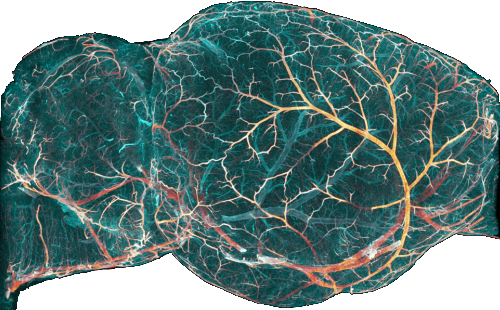
tube_map#
Vasculature binarization, graph construction, and vessel-type annotation.
Two pipeline workers are defined here:
BinaryVesselProcessorConverts raw fluorescence volumes into a binary vascular mask. Steps (configurable order via the GUI pipeline widget):
Binarize — multi-path thresholding (
Vasculature).Smooth — topology-preserving binary smoothing.
Fill — parallel 3-D binary hole filling.
Deep fill — CNN-based hollow-tube filling (
vessel_filling).
Multiple channels (e.g. all-vessels + arteries) are merged by
combine_binary(). Step state is tracked byBinaryVesselProcessorSteps.VesselGraphProcessorConverts the combined binary mask into an annotated vascular graph:
Skeletonize — topology-preserving 3-D thinning.
Build — raw graph from skeleton, radius measurement, artery/vein expression sampling.
Clean — clique removal.
Reduce — degree-2 vertex contraction; edge geometry stored.
Register — atlas-space transform, radius scaling, annotation, distance-to-surface labelling.
Post-process — iterative artery/vein hysteresis tracing.
Step state is tracked by
VesselGraphProcessorSteps.
Radius units#
The graph processor handles three legacy precision levels
(VesselGraphProcessor.RadiusLevel):
FULL — spacing + per-axis µm radii (current).
SCALAR_UM — spacing + scalar µm radii (intermediate legacy).
VOXELS — voxel-space radii only (old graphs,
DeprecationWarningemitted).
Typical usage#
Both workers are accessed via
ExperimentController:
binary = exp_ctrl.get_worker('vasculature', substep='binary')
graph  = exp_ctrl.get_worker('vasculature', substep='graph')

binary.binarize()
binary.postprocess('vessels')
binary.combine_binary()

graph.skeletonize_and_build_graph(binary_processor=binary)
graph.clean_graph()
graph.reduce_graph()
graph.register()
graph.post_process()
See also
ClearMap.ImageProcessing.Experts.Vasculature : Binarization algorithms.
ClearMap.ImageProcessing.machine_learning.vessel_filling : CNN vessel filling.
ClearMap.Analysis.graphs.graph_processing : Graph construction and reduction.
Graph : Graph data structure.
[Kirst2020].
- class BinaryVesselProcessor(sample_manager: SampleManager | None = None, config_coordinator: ConfigCoordinator | None = None)[source]#
Bases:
PipelineOrchestrator- assert_input_shapes_match()[source]#
Ensure that the input shapes (stitched images of the different color channels) match before starting the binarization process since they must overlap.
Warning
stitched may not exist when processor is created. if not, check again in the run/binarize method
- combine_binary()[source]#
Merge the binary images of the different vascular network components into a single mask
- plot_binarization_result(parent=None, channel='', arrange=False)[source]#
- channel str:
The channel to plot
- post_process_binary_combined()[source]#
Postprocess the combined binary image (typically smooth and fill)
- postprocess(channel: str) None[source]#
Run post-processing steps (smooth, fill, deep_fill) for channel in the order declared by step_order in the config.
Binarize is always the first step and is excluded here — it runs via binarize() / binarize_channel() before postprocess is called.
- run()[source]#
Execute the full processing pipeline for this orchestrator.
- Raises:
NotImplementedError – Must be implemented by every concrete subclass.
- setup(sample_manager=None)[source]#
Attach a sample manager and mark this processor as ready.
- Parameters:
sample_manager (SampleManager, optional) – If provided, replaces the currently stored sample manager. When
None, the previously stored instance is reused.- Raises:
ValueError – If the config section identified by
config_nameis absent.
- config_name = 'vasculature'#
- class BinaryVesselProcessorSteps(workspace, channel, config_provider: Callable[[], dict] | None = None)[source]#
Bases:
ProcessorSteps- asset_from_step_name(step)[source]#
Return the on-disk asset that corresponds to step_name.
- Parameters:
step_name (str) – A member of
steps.
Returns
- Asset
The asset associated with that step.
- Raises:
NotImplementedError – Must be implemented by every concrete subclass.
- consume_and_cleanup() None[source]#
Delete the pending temp file once the next step has consumed its input.
- get_last_output() Path | str[source]#
Return the last available output path, used by combine_binary.
- get_source(current_asset: str) Path | str[source]#
Walk backward from current_asset through the configured (non-lifecycle) step order and return the first available backing path.
- Precedence per previous step:
In-memory result stored by record_output (is-not-None guard)
On-disk asset
Raw binary (fallback)
Callers reconstruct the Source with clearmap_io.
- record_output(asset: str, output: Any, temp_path: str = '', keep: bool = False) None[source]#
Store the backing path of a completed step.
Source objects are serialisable path handles — we extract .path so _outputs holds only plain Paths, never live Source instances. clearmap_io reconstructs on demand.
- binary = 'binary'#
- combined = 'combined'#
- deep_filled = 'deep_filled'#
- filled = 'filled'#
- final = 'final'#
- smoothed = 'smoothed'#
- property steps: tuple[str, ...]#
Compute step order fresh on each access — reflects any GUI reordering committed to config since construction.
- stitched = 'stitched'#
- class VesselGraphProcessor(sample_manager: SampleManager | None = None, config_coordinator: ConfigCoordinator | None = None, registration_processor: RegistrationProcessor | None = None)[source]#
Bases:
PipelineOrchestrator- The graph contains the following edge properties:
artery_raw
artery_binary
artery
vein
radii
distance_to_surface
- class RadiusLevel(value)[source]#
Bases:
Enum- FULL = 'full'#
- SCALAR_UM = 'scalar_um'#
- VOXELS = 'voxels'#
- get_filter(graph_step, filter_type, property_name, value)[source]#
Get a filter object for the graph step
- Parameters:
graph_step (str) – The graph step to filter (e.g. ‘annotated’, ‘reduced’)
filter_type (str) – The type of filter to apply (e.g. ‘vertex’, ‘edge’)
property_name (str) – The property name to filter on (e.g. ‘artery’, ‘vein’, ‘radii’)
value (int | float | bool | str | tuple) –
- The value to filter by. Can be:
int/float: exact match
str: string match (e.g. ‘artery’, ‘vein’)
bool: ‘True’ or ‘False’ for boolean properties
tuple: range (min, max) for numerical properties. None means open-ended range.
Returns
- GraphFilter
A filter object for the graph step
- plot_graph_chunk(graph_chunk, plot_type='mesh', title='sub graph', region_color=None, show=True, n_max_vertices=300000)[source]#
- post_process()[source]#
Iteratively refine arteries and veins based on one another.
Delegates to
VesselClassifierwhich encapsulates the full iterative classification algorithm.
- run()[source]#
Execute the full processing pipeline for this orchestrator.
- Raises:
NotImplementedError – Must be implemented by every concrete subclass.
- setup(sample_manager=None, registration_processor=None)[source]#
Attach a sample manager and mark this processor as ready.
- Parameters:
sample_manager (SampleManager, optional) – If provided, replaces the currently stored sample manager. When
None, the previously stored instance is reused.- Raises:
ValueError – If the config section identified by
config_nameis absent.
- visualize_graph_annotations(chunk_range, plot_type='mesh', graph_step='reduced', show=True)[source]#
- property arteries_channel: str#
- property binary_shape#
- config_name = 'vasculature'#
- property graph_annotated#
- property graph_cleaned#
- property graph_raw#
- property graph_reduced#
- property graph_traced#
- registration_processor: RegistrationProcessor | None#
- property resampled_shape#
- sample_manager: SampleManager | None#
- steps: VesselGraphProcessorSteps#
- property use_arteries_for_graph#
- property veins_channel: str#
- workspace: Workspace2 | None#
- class VesselGraphProcessorSteps(workspace: ClearMap.IO.workspace2.Workspace2, channel: str | Sequence[str] = '', step_order_provider: Callable[[], tuple[str, ...]] | None = None)[source]#
Bases:
ProcessorSteps- asset_from_step_name(step)[source]#
Return the on-disk asset that corresponds to step_name.
- Parameters:
step_name (str) – A member of
steps.
Returns
- Asset
The asset associated with that step.
- Raises:
NotImplementedError – Must be implemented by every concrete subclass.
- graph_annotated = 'annotated'#
- graph_cleaned = 'cleaned'#
- graph_raw = 'raw'#
- graph_reduced = 'reduced'#